Developer Tools●Mid
Detect any website's tech stack with Python
Tech stack detector powered by RapidAPI; Wappalyzer and StackShare do this already.
Niche Gem
dapdev
113mo ago
Batch analysis and stack comparison beats BuiltWith's $295/mo starting price.
Sales engineers, competitive analysts, lead enrichment teams, security auditors
BuiltWith API · Wappalyzer · WhatRuns
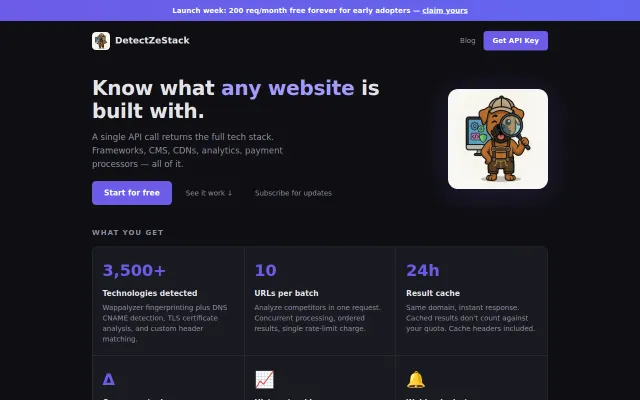
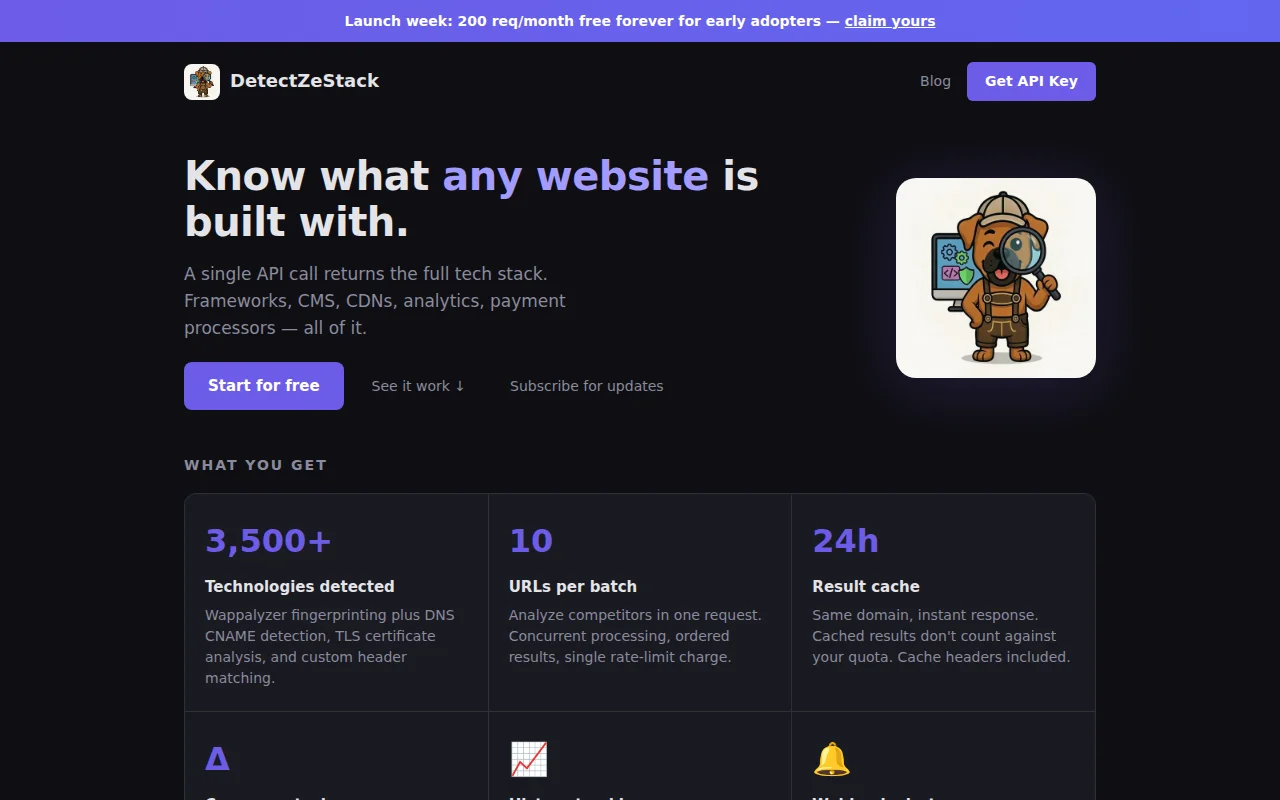
I built DetectZeStack, a REST API that identifies the technologies behind any website.
What it does: Give it a URL, get back a list of frameworks, CMS platforms, CDNs, analytics tools, and more — with confidence scores and metadata for each technology.
How detection works: - Wappalyzer fingerprinting (3,800+ signatures from HTML, headers, cookies, scripts) - DNS CNAME resolution (maps CNAMEs like *.cloudfront.net to CDN providers) - TLS certificate issuer analysis (identifies SSL providers like Let's Encrypt, Cloudflare, DigiCert) - Custom HTTP header matching (catches platforms like Railway that have unique headers)
Endpoints: - GET /analyze?url= — single URL analysis - POST /analyze/batch — up to 10 URLs concurrently, with CSV export - POST /compare — compare tech stacks between sites (shared vs unique) - GET /history — track how a site's stack changes over time - POST /webhooks — get notified when a domain is analyzed - GET /stats — your usage analytics (top domains, daily trends, cache hit rates)
Technical details: - Built in Go, deployed on Fly.io, SQLite for storage - Results cached 24 hours (cache hits don't count against quotas) - HMAC-signed webhook delivery, SSRF protection, AES-256-GCM encrypted secrets - Free tier: 100 requests/month, no credit card
Available on RapidAPI: https://rapidapi.com/mlugoapx/api/detectzestack
OpenAPI spec: https://detectzestack.fly.dev/openapi.yaml
I'd appreciate any feedback on the API design, detection accuracy, or use cases I haven't considered. Happy to answer questions about the implementation.
Tech stack detector powered by RapidAPI; Wappalyzer and StackShare do this already.
Yet another stack analyzer competing with Wappalyzer and BuiltWith.
Combines Wappalyzer fingerprints with DNS CNAME, TLS issuer checks and header matching to triangulate tech stacks — a practical, non-flashy way to catch what single-source scrapers miss. Batch analysis, compare endpoints, CPE IDs for NVD mapping and 24h smart caching make it genuinely useful for audits and competitor research; it's not reinventing the space, but it adds meaningful, usable layers that established tools often omit.
Wappalyzer detection + DNS + SSL in one cached API, but is mostly orchestration of existing tools.
Archived repo with zero stars and README that's just Wikipedia links about hypertext.
It's an essay website with predictions, not a tool or product with technical substance.