Developer Tools●●●Banger
Git-issues – Issue tracker that lives in your repo as Markdown
Issues as Markdown files in your repo means they finally travel with your branches.
Big BrainSolve My ProblemZero to One
steviee
141mo ago
Git-native issues AI agents can manage, but GitHub Issues + MCP already solve this better.
Developers using AI coding assistants (Claude, Cursor, Cline); teams preferring git-native workflows over external trackers
GitHub Issues · Linear · Plane
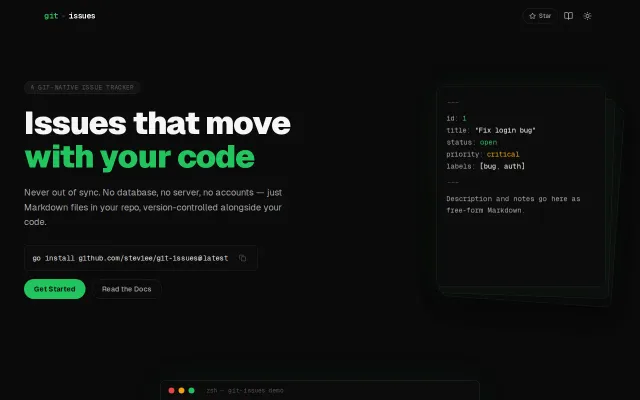
The idea is simple: issues should live with your code. They show up in diffs, travel with branches, and don't require accounts, databases, or external services. They're just markdown files with YAML frontmatter.
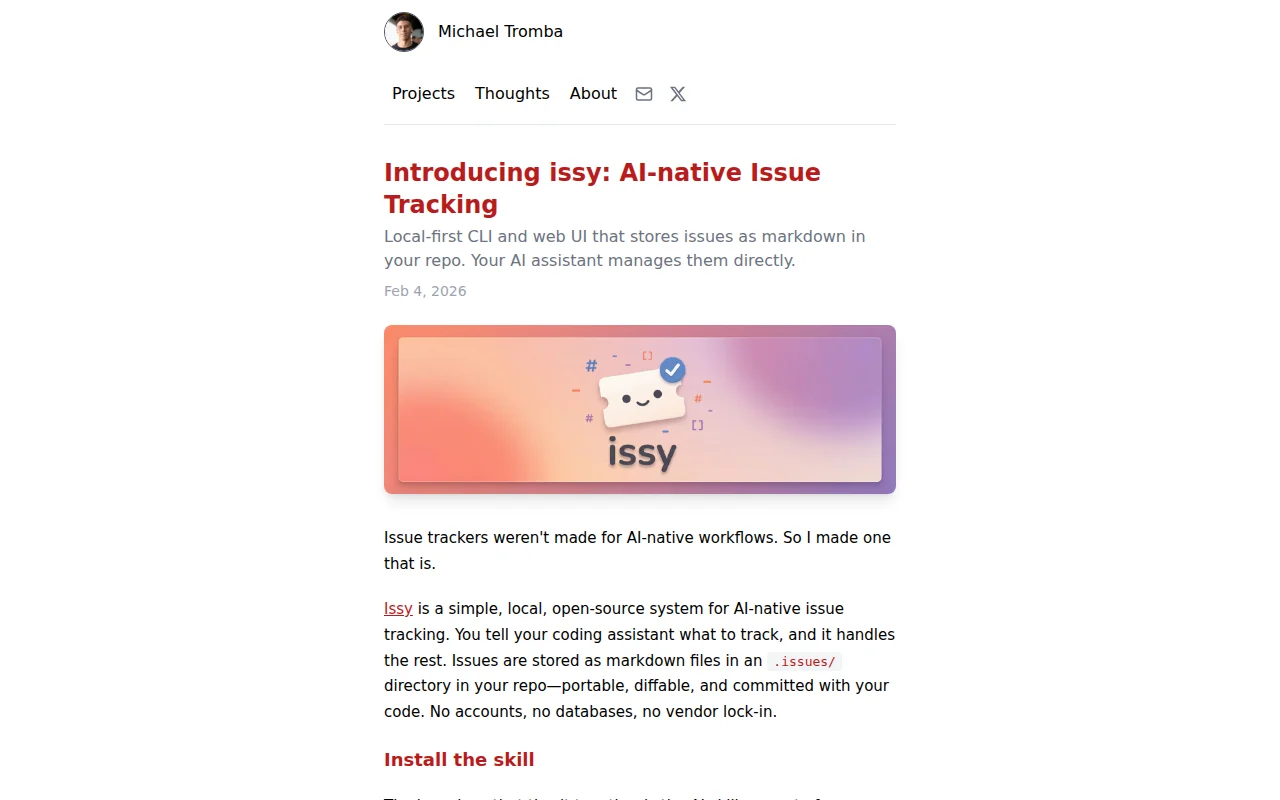
It's built for AI coding assistants. You can tell Cursor/Claude/Codex (or any AI agent) things like "create a bug for the login redirect issue, high priority" and it handles the rest — creating, searching, updating, and closing issues through natural language. There's a Cursor skill you can install with `npx skills add miketromba/issy`.
It also comes with a CLI for filtering/searching and a local web UI at localhost:1554 for when you want a visual overview.
Key points: - Zero infrastructure — no DB, no accounts, no SaaS - Issues are git-native — visible in PRs, blame-able, branch-able - Fuzzy search with typo tolerance - Monorepo-aware (walks up the directory tree to find .issues/) - Works offline
Blog Post: https://mike.gg/issy
Issues as Markdown files in your repo means they finally travel with your branches.
Issues as versioned Markdown files means you can branch, revert, and diff task history with git.
Issues as Git commits, finally solving Linus's 2007 proposal after 17 years.
Git-native issues as markdown files, but GitHub Issues, Gitea, and Fossil already solve this.
Markdown files as database with 1000-token context summaries for AI assistants via MCP.
Catches App Store rejections by scanning binaries locally instead of source code.