Security●●Solid
Open-Source ShadowStrike Phantom EDR/XDR Platform Progress-Post
Custom kernel driver with 1.5M+ lines of code competing against CrowdStrike and SentinelOne.
WizardryBold Bet
Soocile
121mo ago
ShadowStrike A Windows EDR Platform
Ambitious but code doesn't compile yet; shipping in 3-5 years is not a product.
Windows security researchers, open-source security maintainers, aspiring EDR engineers.
Yara · ClamAV · OSSEC
This project is still pre-alpha. It does not compile yet, the codebase is large and messy, and many components are under heavy refactoring. I’m sharing it early because I’d rather build in public and learn from feedback than wait for perfection.
The focus so far has been understanding how EDR systems are structured and implementing core building blocks, including:
- A custom Windows kernel monitoring sensor - Detection logic around process, filesystem, registry, and memory behavior - Memory-mapped data stores for performance (hash/pattern/signature) - Pattern matching experiments using Boyer Moore techniques - Aho Corasick - B+Tree - Boyer Moore - KMP Failure functions - Z algorithms - HeapTrie Nodes , etc. - SQLite-backed management storage
I’m currently evaluating architectural directions such as hypervisor-based protection versus relying on the Windows Hypervisor Platform, and working on improving low-level reasoning by studying reverse engineering tools and kernel debugging workflows.
The biggest challenges so far have been: - managing complexity as the codebase grew - designing boundaries between kernel/user components - balancing experimentation with maintainability
This is a multi-year learning project, not a finished product. My rough goal is to reach a cohesive working version with integrated modules and UI in the coming years.
I’d appreciate technical feedback, criticism, or architectural suggestions.
Custom kernel driver with 1.5M+ lines of code competing against CrowdStrike and SentinelOne.
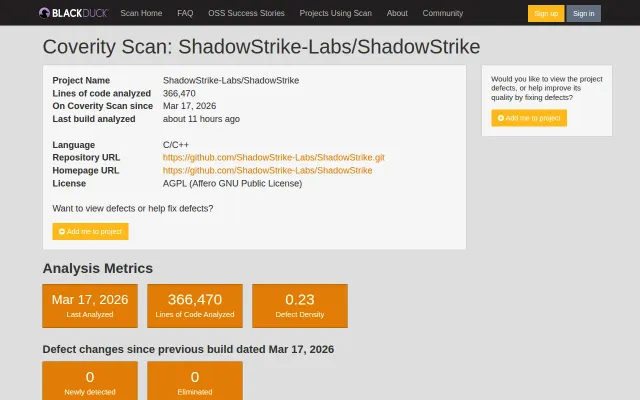
Coverity dashboard shows 93 defects across 366k lines of C/C++ code.
Rust EDR with eBPF on Linux competes against CrowdStrike and Wazuh.
Satirical jab at Microsoft that actually removes Copilot, bloat, telemetry locally.
Charging $99/month for physics constants that are freely available in any reference database.
Home dialysis safety network with mock IoT when remote patient monitoring is heavily regulated.