Developer Tools●●Solid
Navox Agents – 8 AI Agents for Claude Code with HITL Checkpoints
Multi-agent orchestration for Claude Code CLI with human checkpoints instead of full autonomy.
Niche GemShip It
nahrin
112mo ago
The agent infrastructure that chatbot wrappers forgot to build. Missions, councils, sandboxing, hybrid memory, and human-in-the-loop controls. Not a wrapper — an OS. Apache 2.0.
Runtime pause-and-resume checkpoints during execution plus per-agent escalation policies are a rare, practical safety feature — not just a pre-flight approval checkbox. The hybrid memory that scores vector similarity, BM25 keyword relevance, and entity/relation overlap together is a smart middle path between heavyweight graph DBs and plain vector stores. There's real engineering here (Docker compose, 55/55 tests, telemetry endpoints), though I'd like to see benchmarks and how the in-process GraphRAG scales versus external vector/graph services.
Backend/AI engineers, researchers and teams building production-grade autonomous agents with safety and audit requirements
Key things I cared about that most frameworks skip:
- Runtime HITL checkpoints — pause mid-execution when risk is high, resume from exact state - Hybrid memory: vector + BM25 keyword + graph entities/relations scored together, no external dependencies - Security as a primitive: path jail sandbox, OTP pairing, XOR-encrypted local secrets - 22+ LLM providers with per-agent model policy and fallback chains - Multi-agent councils with debate rounds, soul evolution, and skill memory
Node.js, Prisma, Postgres/Redis, Docker. 55/55 tests passing. Apache 2.0.
Happy to answer questions about any of the architecture decisions.
Multi-agent orchestration for Claude Code CLI with human checkpoints instead of full autonomy.
Vocabulary governance solves agent memory cold-start better than raw GraphRAG.
Autonomous memory healing every 5 min, but Mem0 and LangGraph already solve this.
Kernel-level intent tracking stops AI exfiltration where EDR and Docker fail.
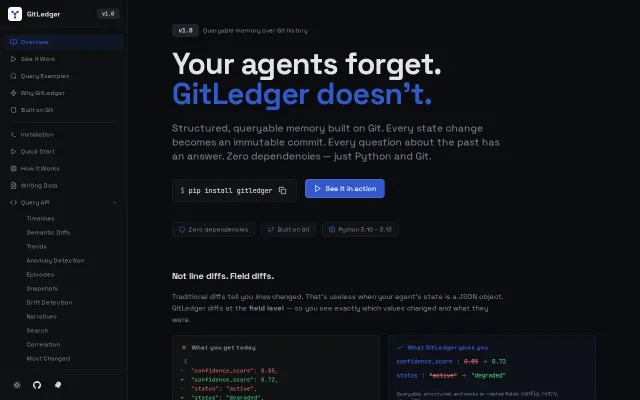
Field-level JSON diffs beat line diffs when your agent state isn't code.
Sandbox agents via natural-language policy, not ambient authority—genuinely novel approach.