AI/ML●●●Banger
Hivemind turns agent traces into skills and shares with your team
Team-wide agent skill sharing via trace capture—nobody's solved this coordination problem yet.
Zero to OneBig Brain
davidbuniat
501mo ago
Addresses real agentic drift, but market timing and adoption risk remain unproven.
Engineering teams using AI agents for coding; product teams building primarily through prompts
Cursor (editor-native agent context) · Continue (codebase-aware agent IDE) · Sourcegraph Cody (shared codebase context for agents)
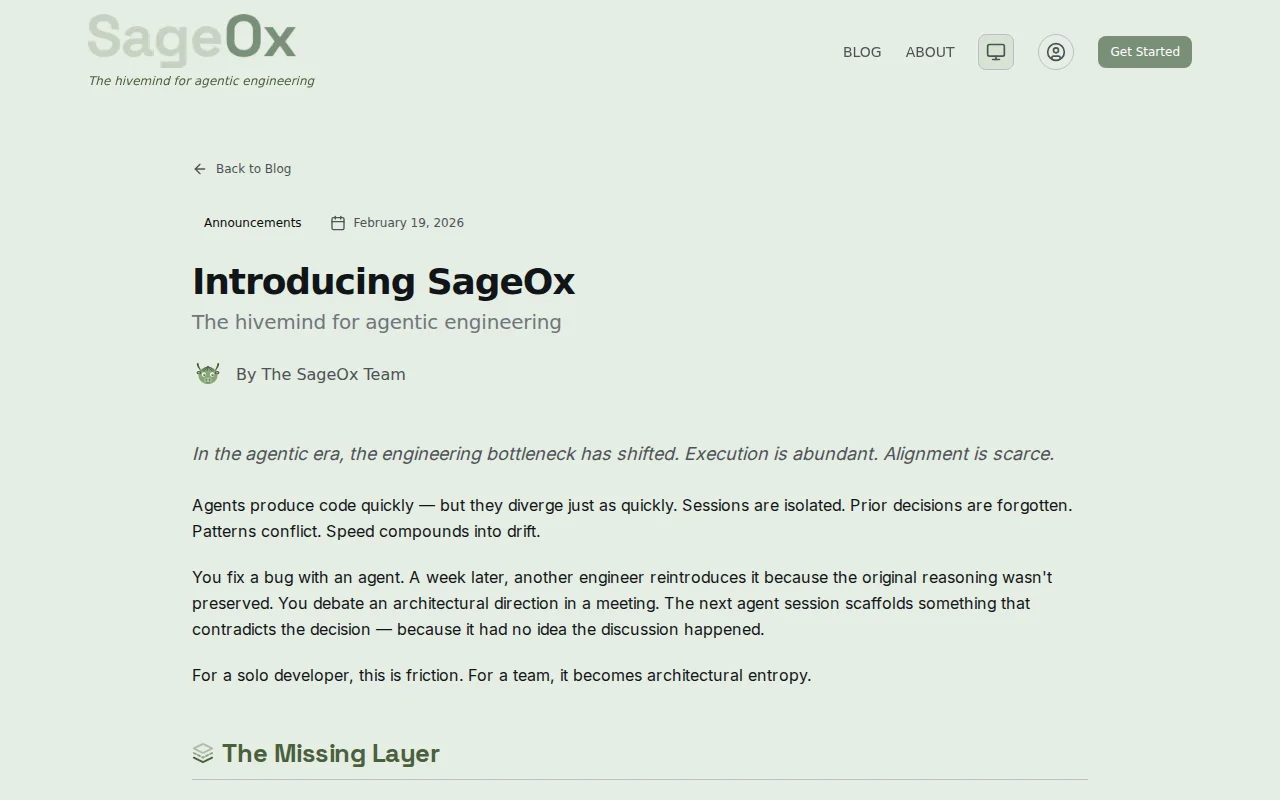
Claude can generate code quickly — but they don’t share team memory.
Each session starts from scratch. Architectural decisions made yesterday aren’t visible today. A technical debate disappears unless someone manually documents it.
Speed increases, but drift leads to architectural entropy and compounding rework.
What SageOx Does
SageOx provides shared, queryable team memory that humans and agents automatically draw from before they act.
Capture We capture intent as it emerges, always with permission: - Technical meetings - Product discussions - Human–agent coding sessions
Structure Architectural decisions, constraints, conventions, and implementation reasoning become durable, searchable artifacts.
For example, if two engineers decide to standardize on git-lfs instead of git for our media artifacts, that decision (and its rationale) becomes searchable context for future sessions.
If a developer collaborates with Claude to implement a feature, the reasoning behind the implementation becomes part of team memory — without anyone manually writing documentation.
Consult When you start Claude, ox gets primed and automatically retrieves relevant team context — recent decisions, architectural constraints, related discussions — and injects it into the session.
There’s also a web app for reviewing structured context, managing members, connecting repositories, and inspecting the ledger.
Building in Public (Open Work) - come check us out
Demo: https://sageox.ai/blog/introducing-sageox
The Ox CLI itself is built using SageOx, and signed-in users can see: - The debates behind technical decisions - Trade-offs we considered - Moments where we changed direction - The human–agent sessions that produced specific changes
Not just what we shipped — but how we reasoned our way there.
We think this level of inspectable reasoning becomes important as more engineering work is done through AI agents.
Try it! Right now, SageOx v0.1 is for Claude users building entirely through prompts.
If you’re coordinating across engineers using coding agents and seeing drift or repeated decisions, we’d appreciate feedback.
>_ Claude Prompt: Take a look at gh sageox/ox and install the cli
>_ Claude Prompt: ox login
Happy to answer technical questions about architecture, context capture, retrieval, or tradeoffs vs. traditional documentation.
Team-wide agent skill sharing via trace capture—nobody's solved this coordination problem yet.
Path-scoped memory beats project-wide rules files for team context sharing.
Local memory for AI agents that actually learns from your last 50 sessions, not just context window tricks.
Hierarchical scopes let teams share code style rules across agents.
Agent skill marketplace, but cold-start problem and spam incentives unproven.
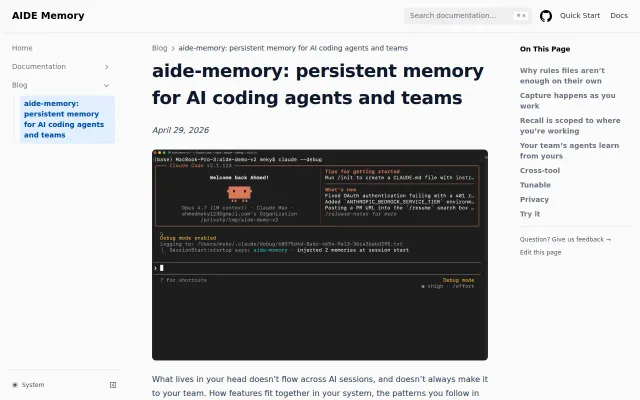
AI memory layer with audit trails, but pre-1.0 and lacks live integrations.