Security●●●Banger
AST-guard – Fast, zero-cost structural checks for LLM code execution
Deterministic AST analysis catches AI code bypasses that LLM reviewers miss, verified on 77k+ samples.
Big BrainWizardry
thinking-nick
208d ago
AST-verified AI code audits prevent hallucinations; LLM findings checked against parser ground truth.
Engineering teams using AI coding agents (Claude, Cursor, Cline), regulated industries (fintech, healthcare, government).
Semgrep · SonarQube · Snyk Code
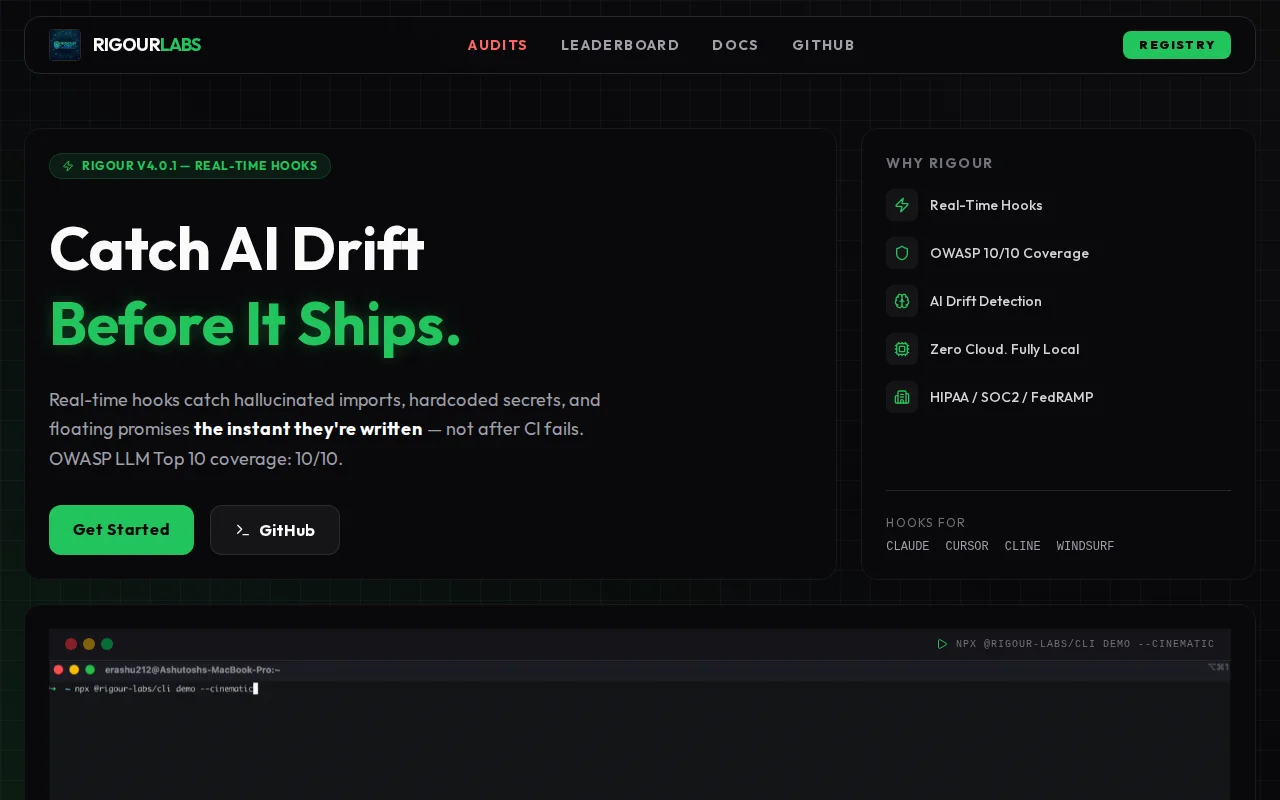
I built Rigour, an open-source CLI that catches quality issues AI coding agents introduce. It runs as a quality gate in your workflow — after the agent writes code, before it ships.
v4 adds --deep analysis: AST extracts deterministic facts (line counts, nesting depth, method signatures), an LLM interprets what the patterns mean (god classes, SRP violations, DRY issues), then AST verifies the LLM didn't hallucinate.
I ran it on PicoClaw (open-source AI coding agent, ~50 Go files):
- 202 total findings - 88 from deep analysis (SOLID violations, god functions, design smells) - 88/88 AST-verified (zero hallucinations) - Average confidence: 0.89 - 120 seconds for full codebase scan
Sample finding: pkg/agent/loop.go — 1,147 lines, 23 functions. Deep analysis identified 5 distinct responsibilities (agent init, execution, tool processing, message handling, state management) and suggested specific file decomposition.
Every finding includes actionable refactoring suggestions, not just "fix this."
The tool is local-first — your code never leaves your machine unless you explicitly opt in with your own API key (--deep -k flag).
Tech: Node.js CLI, AST parsing per language, structured LLM prompts with JSON schema enforcement, AST cross-verification of every LLM claim.
GitHub: https://github.com/rigour-labs/rigour
Would love feedback, especially from anyone dealing with AI-generated code quality in production.
Deterministic AST analysis catches AI code bypasses that LLM reviewers miss, verified on 77k+ samples.
TDD state machine leash for Claude Code avoids agent drift, but niche audience.
Work-review-gate loop automates Claude iteration, but templated agentic loops already exist at scale.
465 passing tests from 5,000+ production executions—guards that don't get tired.
AI-specific linting catches hallucinated packages; but static analysis won't catch logic gaps reliably.
Multi-agent tmux orchestrator with receipt ledger, but still early and narrow audience.