Developer Tools●●Solid
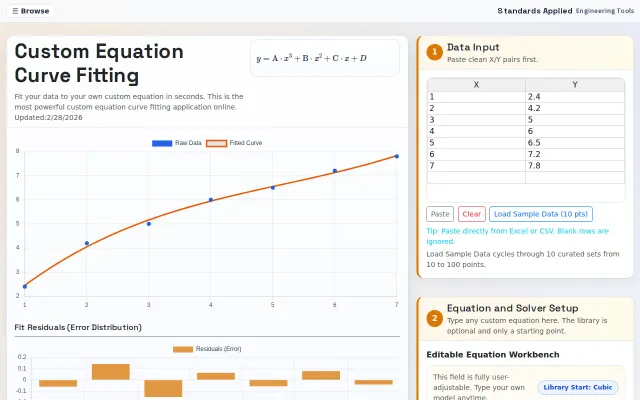
Custom Equation Curve Fitting
Custom equation fitting beats preset-only tools, but Desmos and CurveExpert exist.
Solve My ProblemCozy
Standards1
203mo ago
DRESS: A Continuous Framework for Structural Graph Refinement
Provably stronger than Weisfeiler-Leman without parameters—pure graph math, peer-reviewed.
Graph ML researchers, computational chemists, and network scientists evaluating graph isomorphism and structure analysis.
Weisfeiler-Leman algorithm · Graph Neural Networks (GNNs) · PyTorch Geometric
I published the original equation in 2018 (arXiv:1805.01419). I've now proved it's strictly more powerful than 1-WL (Weisfeiler-Leman colour refinement) — the standard benchmark for graph neural network expressiveness. The proof uses the prism graph vs K₃,₃, the textbook pair that 1-WL can't separate. DRESS distinguishes them because it works on edges, and different edge roles (triangle edges vs bridge edges) force different fixed-point values.
Two extensions — Motif-DRESS and Δ-DRESS — empirically distinguish Strongly Regular Graphs that defeat 3-WL, at near-linear cost instead of O(n⁴).
The library is written in C with bindings for C++, Python, Rust, Go, Julia, R, MATLAB, and WebAssembly. pip install dress-graph to try it.
Paper: https://github.com/velicast/dress-graph/blob/main/research/k...
Docs: https://velicast.github.io/dress-graph/
Looking for feedback. What am I missing? What should I test next?
Custom equation fitting beats preset-only tools, but Desmos and CurveExpert exist.
Directed hypergraphs in Rust with persistent snapshots and a generic query trait.
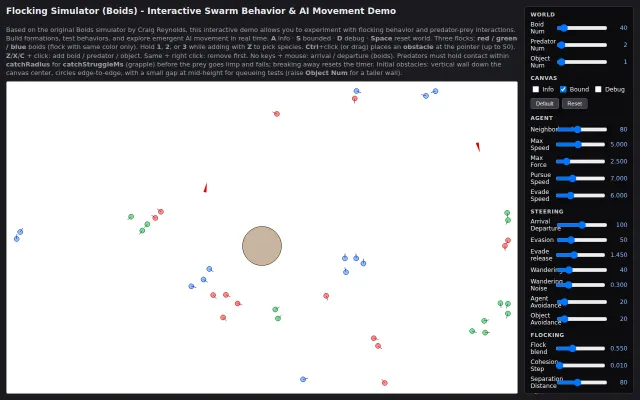
Deeply tunable boids simulation that visualizes emergent flocking behavior in real time.
Real-time visual Web Audio graphs with signal injection—finally see what connect() actually does.
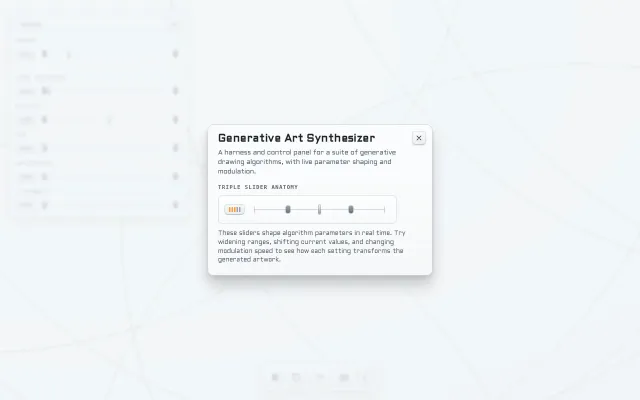
Slider-tweaked generative art algorithms, but Processing, p5.js, and OpenFrameworks already do this.
ACORN-1 pushes WHERE filters into HNSW traversal, fixing pgvector's post-filter limitation.