Security●Mid
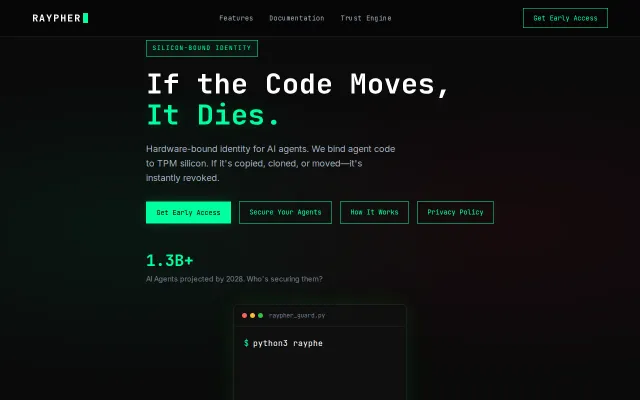
Raypher – a Rust-Based Kernel Driver to Sandbox "Bare Metal" AI Agents
Kernel-level agent sandboxing via eBPF, but alpha code with kernel panics and unproven reliability.
Bold BetWizardry
Kidiga
104mo ago
Tamper-proof memory + cryptographic audit trail for AI agents. HIPAA, SOC2, GDPR compliance built-in. Trust score for every response. Python & TypeScript SDKs. Rust-powered.
Content-addressed memory + Merkle-chained ops = tamper-proof AI agent audit trail.
Enterprise AI teams, compliance officers, multi-agent system builders
connector-oss is an in-process Rust kernel that adds memory integrity primitives to existing agent frameworks (LangChain, CrewAI, AutoGen).
How it works:
1. Every memory write is content-addressed with Blake3 — the CID is deterministic, so any modification to stored content produces a different CID and is detected on next read.
2. Every agent operation is logged to an Ed25519-signed Merkle chain. The chain links H(n) = hash(H(n-1) + op_n), so altering any entry breaks every downstream entry. Retroactive tampering is detectable.
3. Namespace isolation is enforced at the Rust kernel level — agents are confined to their namespace in vac-core, not by a Python convention that can be bypassed.
4. An 8-dimension trust score (consistency, accuracy, recency, isolation, integrity, coverage, coherence, provenance) is computed from kernel state — not from LLM self-report.
Crate structure: - vac-core: MemoryKernel, 28 syscalls, RangeWindow, Interference engine - vac-store: ProllyKernelStore (Prolly Tree + Blake3), IndexDbKernelStore - vac-ffi: ~500-line PyO3 thin wrapper - connector-engine: AgentFirewall, DualDispatcher, KnowledgeEngine - connector-server: axum REST + Prometheus metrics
One interesting problem: the Prolly Tree backend is async (tokio) but PyO3 calls are synchronous. We bridge this with block_in_place + handle.block_on(), which requires flavor = "multi_thread" in tokio test configs. Namespace packet keys include a timestamp to avoid CID collisions: ns:{ns}:{ts}:{cid}.
788 tests, 0 failures. <50μs overhead per memory operation. 4-agent pipeline produces 105 audit entries, integrity check passes.
pip install connector-oss Apache 2.0. ```
Kernel-level agent sandboxing via eBPF, but alpha code with kernel panics and unproven reliability.
Deterministic graph memory that traces every result back to ingested data—no hallucination by design.
Extends Rust's ownership model across GPU boundary with tile-based partitioning for data-race-free kernels.
This repo actually wires an OpenCode agent to Membrane so the agent can find existing connectors and synthesize missing ones on the fly — intent becomes action, not just a toy prompt example. It ships a runnable Next.js UI and clear quick-start steps, which makes the idea tangible fast; what I'd like to see next are security notes, more examples of complex connector synthesis, and tests that prove the approach scales beyond demos.
Local-first AI agent desktop app with 75 tools, but ChatGPT, Continue, and Cursor already own this space.
Parameter-level approval prevents agents from changing approved values after you authorize.