AI/ML●●●Banger
Standing Questions – agent memory that stores questions, not answers
Questions self-heal; answers rot. Novel memory pattern for AI agents.
Big BrainZero to One
Kadiwar
1011d ago
Human-like memory for AI agents — semantic, episodic & procedural. Experience-driven procedures that learn from failures. Free API, Python & JS SDKs, LangChain, CrewAI & OpenClaw integrations.
Procedures that learn from failures—not just facts; agents improve through experience loops.
AI agent builders, LangChain/CrewAI developers, teams scaling agentic workflows
Mem0 (persistent AI memory) · Zep (session memory + embeddings) · Letta (persistent agent state)
Mengram stores 3 types: semantic (facts), episodic (events/decisions), and procedural (workflows). The key difference: procedures evolve when they fail. Week 1: deploy → build → push (fails: forgot migrations) Week 2: deploy v2 → build → migrate → push (fails: OOM) Week 3: deploy v3 → build → migrate → check memory → push This happens automatically from conversations — report a failure, the procedure evolves. Stack: Python, PostgreSQL + pgvector, FastAPI. Free cloud API, self-hostable, SDKs for Python/JS, integrations with LangChain, CrewAI, MCP. Honest limitations: extraction quality depends on LLM, procedural evolution needs clear failure descriptions, no real-time streaming yet.
Would love feedback on the memory model — is 3 types the right abstraction, or too complex?
Questions self-heal; answers rot. Novel memory pattern for AI agents.
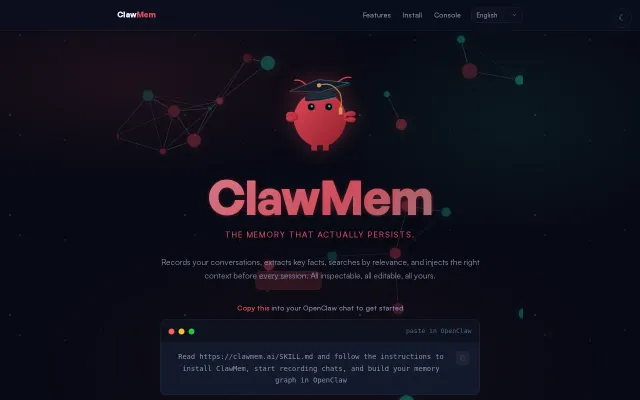
Markdown files are the source of truth—embeddings are just a cache, not the database.
Inspectable memory records beat black-box embeddings for AI agent context persistence.
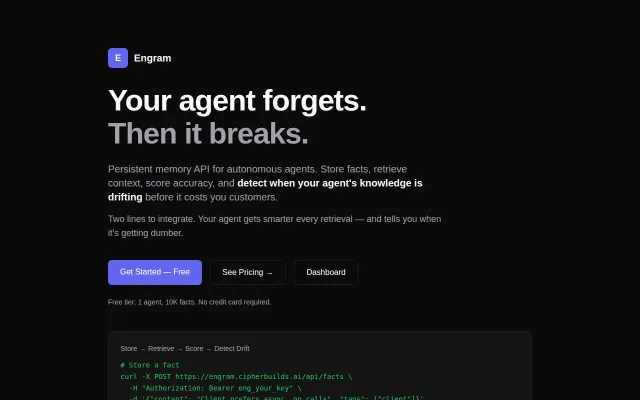
Mem0 stores facts, but Engram detects when they go stale and break your agent.
Memory deduplication and contradiction detection, but vector DBs already do semantic search.