Security●●●Banger
How to analyze your LLM output – A behavioural health monitor for LLMs
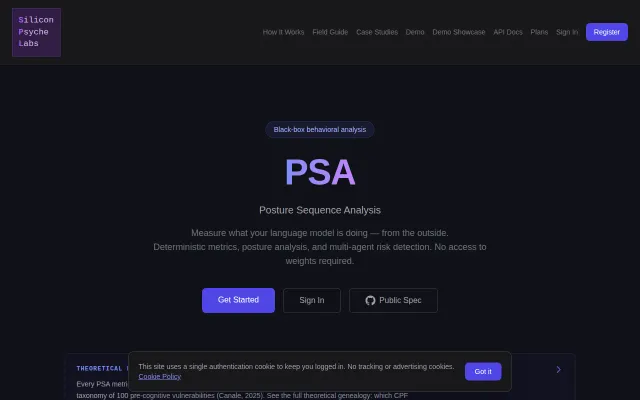
Detects sycophancy and jailbreak drift in LLMs without needing model weights.
Big BrainBold BetNiche Gem
k-thimmaraju
10726d ago

Hallucination detector for LLMs, but existing tools like Guardrails and Langfuse already do this.
Backend engineers building LLM applications
Guardrails.ai · Arthur AI · Langfuse
I’ve been building LLM apps for a while, and one thing kept bothering me is that models will say completely wrong things with total confidence. Not edgy wrong or funny wrong, just confidently fabricated citations, broken reasoning, medical summaries that look plausible but aren’t. The kind of stuff that’s fine in a chatbot but sketchy in production.
So I built PsiGuard. It’s a lightweight SDK that wraps around your existing LLM call and scores the output for likely hallucination patterns. It returns structured metadata (confidence score, flags, anomaly signals) and lets you decide what to do — log it, warn, or block.
The goal isn’t to replace the model. It’s to add a safety layer.
Basic usage looks like:
from psiguard import monitor response = monitor(llm_output) print(response.score, response.flags)
It’s early, but it’s working well in my testing across general Q&A and domain-specific prompts.
Repo: https://bumpr-ai-safety-rafj.onrender.com/ SDK: pip install psiguard
I would very much appreciate feedback, especially from anyone running LLMs in production or dealing with hallucination mitigation in real apps.
Detects sycophancy and jailbreak drift in LLMs without needing model weights.
Yet another hallucination checker when Guardrails and LMQL already cover this.
Detects hallucinations via hidden state geometry in under 1ms with no training required.
Detects hallucinations via latent space geometry instead of text analysis, but 54% detection rate is incomplete.
Detects hallucinations mid-generation via hidden state geometry, not output analysis.
Peer-reviewed LLM hallucination detector using uncertainty quantification, published in JMLR and TMLR.