Finance●Mid
Knox–Full Stack L1 Post-Quantum Privacy Crypto (Built with My 11yo)
Post-quantum privacy blockchain built from scratch, but Monero already does ring signatures well.
Big BrainBold Bet
KnoxProtocol
103mo ago
KNOX is the world's first fully end-to-end lattice-based privacy blockchain. Post-quantum ring signatures, confidential transactions, stealth addresses, and lattice-encrypted P2P — across every protocol layer. Not a fork. Built from the ground up. Mainnet live.
Post-quantum L1 chain, no forks, pure lattice crypto stack with CUDA GPU acceleration.
Cryptographers, blockchain developers, post-quantum security researchers
Monero · Zcash · Aztec Protocol
If you are building a 100% post-quantum chain with no classical hashing, Rust isn't just a stylistic choice—it’s the only way this network survives.
Here is why the codebase is an absolute anomaly:
The Stack Isolation They didn't build a monolithic mess. The core crates (knox-node, knox-core, knox-ledger, knox-lattice, knox-p2p, knox-storage) are 100% pure Rust. The UI is completely decoupled into an Electron app (JS/React JSX) that talks to the knox-wallet Rust crate, and the GPU heavy-lifting is offloaded to a custom CUDA C kernel (kernelcuda1.cu). It is a strictly disciplined, production-ready stack.
Why Rust is the Only Language for VeloxReaper KNOX uses an anti-ASIC PoW called VeloxReaper that forces the hardware to continuously thrash a 512MB DRAM DAG.
If this were written in Go or Java, the Garbage Collector pauses would absolutely destroy the block-timing mechanics for their Proof-of-Time consensus (CLH).
If it were written in C++, a single memory leak during the continuous O(nlogn) NTT polynomial multiplications would eventually crash the node.
Rust’s borrow checker guarantees memory safety without a GC, allowing the CPU to feed the CUDA kernel at maximum bandwidth without dropping a single frame.
Fearless Concurrency on the P2P Layer Their P2P gossip layer is built on the Tokio async runtime. Because KNOX uses a two-round lattice key exchange (ML-KEM) instead of classical Diffie-Hellman, and masks traffic with 1KB padded packets on randomized 120ms–900ms jitters, the network handles a massive amount of concurrent cryptographic overhead. Rust ensures they don't get race conditions or thread-locking when the network gets slammed.The Kicker There is an 11-year-old kid actively contributing to memory-safe, async Rust code for a ground-up, post-quantum Layer-1 blockchain.
There is no VC funding here. No copied Ethereum code. Just a father and son writing fearless-concurrency Rust to build a mathematical fortress.
Post-quantum privacy blockchain built from scratch, but Monero already does ring signatures well.
Ambitious lattice PoW blockchain, but unverified claims and no working mainnet or active community evidence.
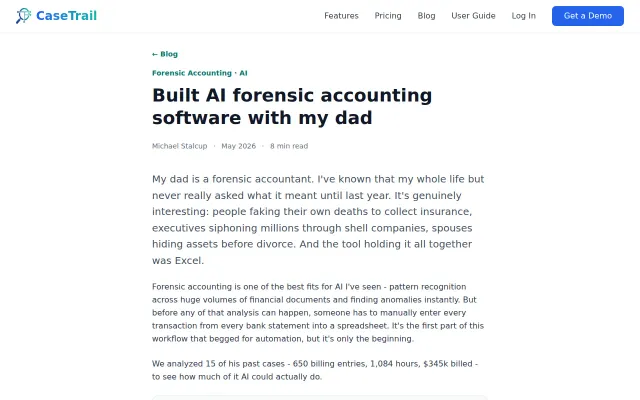
Automates 90% of document intake for forensic accounting cases.
Vibe-coded SGI Indy emulator in Rust that actually boots IRIX 6.5 with X11.
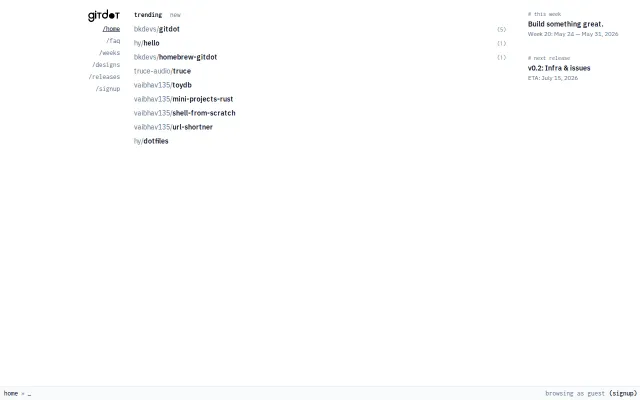
CLI-inspired web UI is genuinely unusual—fzf meets GitHub.
O(1) anti-hoarding with atomic CAS beats glibc 26% on packet processing, 9x less fragmentation.