Infrastructure●Mid
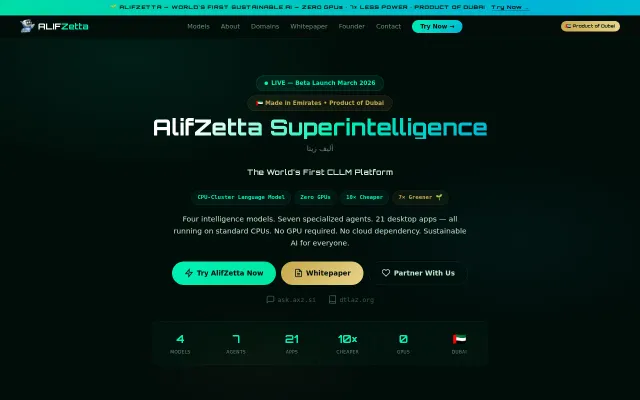
AlifZetta – AI Operating System That Runs LLMs Without GPUs
CPU-only LLM inference via vGPU SIMD, but prototype status and deployment clarity unclear.
Big BrainBold Bet
padamkafle
413mo ago
Per-job GPU cost breakdown where cloud bills and nvidia-smi fail to deliver.
ML engineers and researchers running GPU training jobs who need fine-grained cost attribution.
Weights & Biases (cost tracking module) · Paperspace Gradient (cost monitoring) · Lambda Labs billing dashboards
The problem: nvidia-smi shows you watts right now. Your cloud provider shows you a monthly total. But nothing tells you which training job was the expensive one.
AluminatiAi fills that gap. A Python agent (using NVML via pynvml) runs on your GPU machine, samples power every 5 seconds, and uploads metrics to a Next.js + Supabase dashboard. It tracks energy in kWh and converts to dollars at your electricity rate. Tag your runs with job names and you get full per-job cost attribution.
Tech stack: Python + pynvml for the agent, Next.js + Supabase for the platform, Recharts for the dashboard. Open source and free to try (30-day trial, no credit card). Works on any NVIDIA GPU — tested on A100, H100, RTX 4090, and in Google Colab.
GitHub: https://github.com/AgentMulder404/aluminatai-landing Live: https://www.aluminatiai.com
CPU-only LLM inference via vGPU SIMD, but prototype status and deployment clarity unclear.
6-stage job application pipeline with browser automation—solves real friction, but legally sketchy.
Agent runtime infra, but 0 stars and crowded with LangGraph and Temporal.
Scheduled AI agents with per-run cost tracking beat generic chat wrappers.
One decorator caps agent costs, detects loops, logs telemetry—real guardrails for runaway LLMs.
Smart local‑first routing that only escalates to expensive cloud planners when necessary is the standout idea — combined with per‑run cost accounting and full Ollama offline support it solves a real operational itch. The repo is a pragmatic, CLI/TUI-focused toolkit (scraping + cache, MCP server mode) that feels useful for teams wanting a no‑friction orchestrator, but it’s playing in a crowded space of agent frameworks so the novelty is incremental rather than revolutionary.