AI/ML●●●Banger
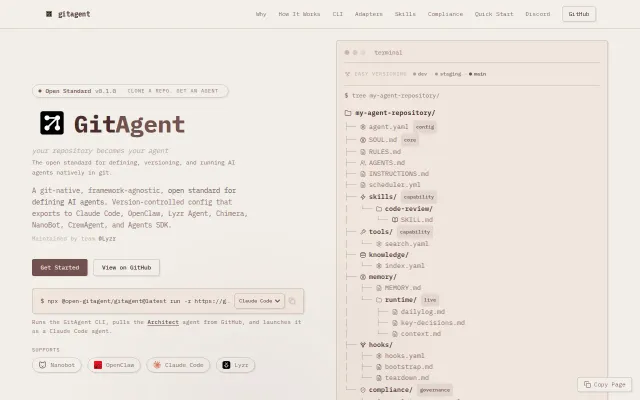
GitAgent – An open standard that turns any Git repo into an AI agent
Git as the agent standard — version prompts like code before LangChain locks you in.
Big BrainZero to OneBold Bet
sivasurend
147393mo ago
Git-as-agent versioning with framework portability, but crowded agent orchestration space.
AI engineers, LLM application developers, teams building multi-framework agent systems
CrewAI · AutoGen · LangChain Agents
Hey HN,
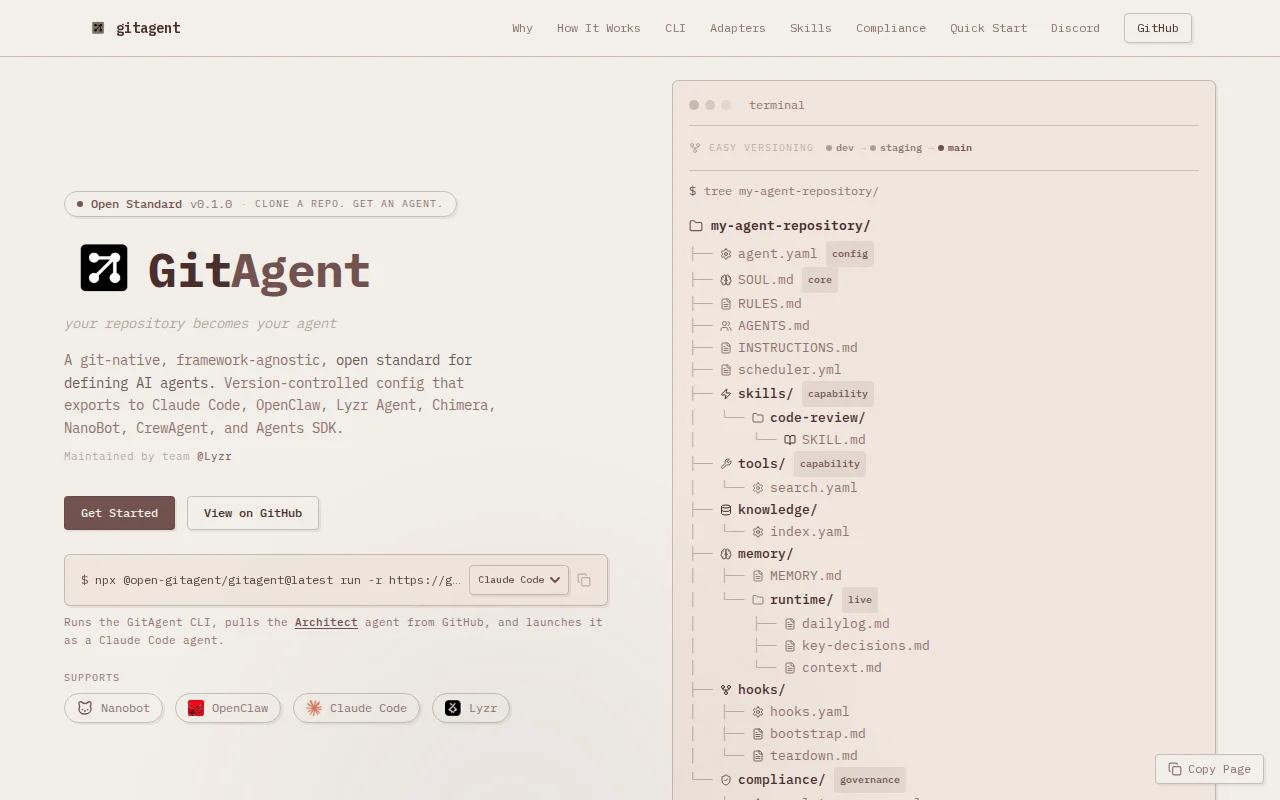
We built GitAgent — a git-native, framework-agnostic open standard for defining AI agents. The idea is simple: your repo IS the agent.
npx @open-gitagent/gitagent@latest run -r https://github.com/shreyas-lyzr/architect -a claude
That one command clones the repo, reads agent.yaml + SOUL.md + skills/, and launches it with Claude Code. Switch `-a openai` or `-a lyzr` to run the same agent on a different framework. No code changes.
Goal: is keep the gitagent as a open standard ledger for an AI Agent in a VM, with versioned memories, skills etc.
An agent is just files:
my-agent/ ├── agent.yaml # config: model, skills, tools ├── SOUL.md # identity, personality, expertise ├── RULES.md # boundaries, constraints ├── skills/ # capabilities ├── knowledge/ # reference docs └── memory/ # persistent context
Why Git? Because agents need the same things code needs — versioning, branching, diffing, code review, and collaboration. We already have
the best tool for that.
What we've built: - CLI that validates, exports, imports, and runs agents - 8 adapters: Claude Code, OpenAI, CrewAI, OpenClaw, Nanobot, Lyzr, GitHub Models - Public registry at registry.gitagent.sh — browse and share agents - Compliance framework (FINRA, SEC, Fed) — audit logging, human-in-the-loop, kill switches
Try it: https://gitagent.sh Registry: https://registry.gitagent.sh GitHub: https://github.com/open-gitagent/gitagent Discord: https://discord.gg/hVZV8Xyjdc Patterns 1. Human-in-the-Loop — Agents create a branch and PR for human review before updating memory or skills.
2. Live Agent Memory — memory/runtime/ stores dailylog.md, key-decisions.md, and context.md to persist state across sessions.
3. Agent Versioning — Every agent change is a git commit. Roll back broken prompts or revert bad skills anytime.
4. Shared Context via Monorepo — Root-level context.md, skills/, tools/, and knowledge/ are inherited by all agents automatically.
5. Branch-based Deployment — Promote agent changes through dev → staging → main, just like shipping software.
6. Knowledge Tree — knowledge/ folder stores entity relationships as a directory tree with embeddings for structured reasoning.
7. Agent Forking & Remixing — Fork a public agent repo, customize SOUL.md, add skills, and PR improvements back upstream.
CI/CD for Agents — Run gitagent validate on every push via GitHub Actions. Test, block bad merges, auto-deploy.8. Agent Diff & Audit Trail — git diff shows what changed; git blame traces every line to who wrote it and when.
Tagged Releases — Tag stable versions like v1.1.0. Pin production to a tag, canary on staging, roll back instantly.9. Secret Management — Agent config is version-controlled; API keys stay in .env excluded via .gitignore.
10. Lifecycle Hooks — hooks/bootstrap.md and hooks/teardown.md define what an agent does on startup and shutdown. 11. Git-Native — Version control, branching, diffing, and collaboration are built in. 12. Framework-Agnostic — Works with Claude Code, OpenAI, CrewAI, LangChain, and more. 13. Compliance-Ready — First-class FINRA, SEC, and Federal Reserve support with audit logging and supervision.
14. Composable — Skills, tools, sub-agents, and workflows can extend, depend on, and delegate to each other.
MIT licensed. Would love feedback.Git as the agent standard — version prompts like code before LangChain locks you in.
K8s-native agent orchestration with CRDs, but Axon is early infrastructure competing against none.
Git-native AI memory that works across tools without installing anything.
Git-native prompt logging for Claude Code—audit trails stay in your repo, not vendor clouds.
Chat-with-your-codebase tool, but Cursor, Continue, and Cody already own this.
Real libgit2 on iOS with Obsidian x-callback-url sync, but Working Copy exists.