Productivity●Mid
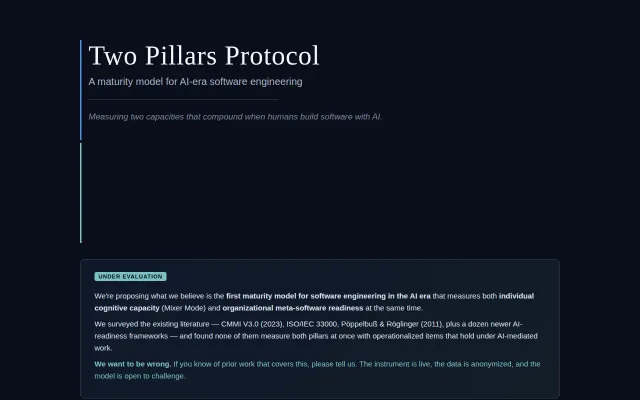
Two Pillars Protocol – a maturity model for AI-era software engineering
Maturity model for AI engineering when CMMI ignores agentic workflows entirely.
Big BrainBold Bet
rlabbe
407d ago
CMMI extension for SDD migration, but lacks validation data and early adoption proof.
Enterprise software quality/engineering leads, organizations adopting AI coding agents, transformation consultants
CMMI · SAFe · TOGAF
CMMI measures process maturity. But it says nothing about how hard it will be to shift from code-centric to specification-centric development. Those are different questions.
So I built a 5-level framework that tries to answer both simultaneously: where you are, and how much work it will take to get to SDD with AI agents.
The levels go from GUIDO 1 (chaotic, very high migration effort) to GUIDO 5 (SDD-native, specs as living source of truth).
The key insight — which I think is non-obvious — is that you can be CMMI Level 3 and still be GUIDO 2. Process maturity and SDD readiness are not the same axis.
It includes a whitepaper, assessment folder, and real-world scenarios.
Honest caveat: this is v1.0, published two weeks ago, zero external validation so far. I'm sharing it here specifically because I want to know if this resonates with engineers who've actually tried to introduce AI agents into their dev pipelines — or if I'm solving a problem that doesn't exist the way I think it does.
What has your experience been? Did your organization skip levels and pay for it?
Maturity model for AI engineering when CMMI ignores agentic workflows entirely.
Replay production queries against shadow DB to catch 92x regressions before they ship.
SQLAlchemy migration tool, but Alembic already dominates this space completely.
Wavelet-based attention-free architecture beats GPT-2 Medium with 80x less training data.
Per-developer AI usage tracking solves enterprise billing headaches nicely.
Maturity model for AI readiness, but consulting frameworks packaged as code.