Security●Mid
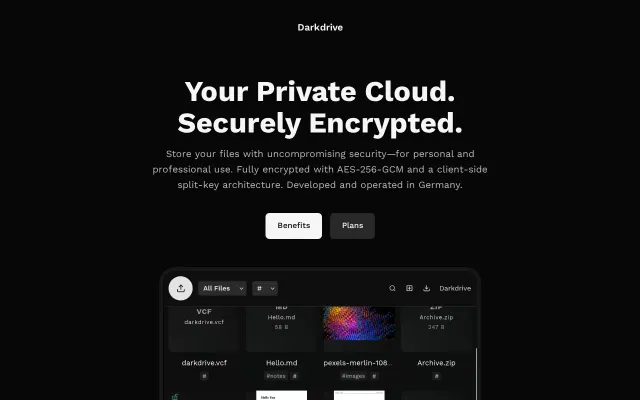

Darkdrive – self-hosted encrypted cloud storage with split keys
Split-key architecture enables file previews, but closed-source code undermines security claims.
SlickBold Bet
plue-tech
102mo ago
Layered security (LUKS+Debian+Docker+token auth) for self-hosted AI; one-command setup.
Privacy-conscious users, self-hosters, developers wanting encrypted local AI infrastructure
Ollama (local AI) · LocalAI · Paperless-ngx (encrypted self-hosted document mgmt)
I got tired of trusting cloud services with my AI conversations — so I built the setup I actually wanted: encrypted disk, hardened OS, one-command deploy.
Demo: https://github.com/congzhangzh/your_openclaw/raw/main/demos/...
The idea is simple: if you're going to self-host AI, do it right — from the bare metal up.
Layer 1 — The disk: LUKS encryption + Btrfs compression (or ZFS native encryption). AI logs, API keys, model configs — everything at rest is encrypted. Someone pulls your disk? They get nothing.
Layer 2 — The OS: Debian Trixie. Stable, predictable, full toolchain. No surprise updates breaking your gateway at 3 AM.
Layer 3 — The container: Docker with Tini as PID 1 (proper signals, no zombies). Data lives on the host as plain files (~/.openclaw) — ls, cp, rsync. No opaque volumes.
Layer 4 — The gateway: OpenClaw with token auth + device approval. Connect Telegram and more. Guided onboard walks you through everything.
The whole setup:
git clone https://github.com/congzhangzh/your_openclaw.git && cd your_openclaw ./shell
That's it. `openclaw onboard` inside the container does the rest.Built-in monitoring (btop, nload, iftop) in the container. Ctrl+P, Ctrl+Q to detach — gateway runs 24/7.
Repo includes VPS disk encryption guides and provider recommendations. MIT-licensed. I use this daily on a cheap European VPS.
Feedback welcome: - Is the layered security overkill or just right? - Are you encrypting your VPS disks? - What AI backends are you running?
Split-key architecture enables file previews, but closed-source code undermines security claims.
mTLS + XOR key splitting beats dropbear SSH for remote FDE unlock.
Nice little CLI: one-liner install and an interactive 'clawstash setup' get you an hourly daemon that auto-downloads restic and uploads AES-256 encrypted, deduplicated blocks to any S3-compatible store. It's pragmatic and tightly scoped — excellent if you run OpenClaw, but mostly a focused wrapper around restic rather than a novel backup system.
OpenClaw orchestration with MCP support, but agent management is crowded.
Per-agent container isolation with separate networks beats shared-instance chaos.
Full agent tool access on every utterance, unlike native realtime plugins.