AI/ML●●●Banger
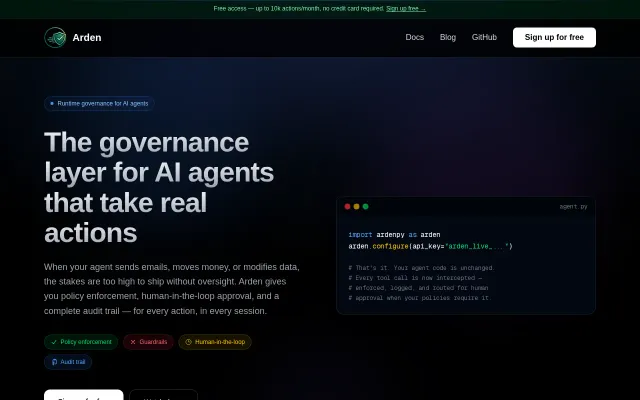
Arden – Runtime policy enforcement and governance for AI agents
Intercepts tool calls before execution to block dangerous actions like DB deletes.
Solve My ProblemBold Bet
rishabtandon
851mo ago
Constrained autonomy runtime for AI agents.
Deterministic agent governance with capability tokens beats probabilistic guardrails.
Developers building autonomous agents with safety requirements
LangSmith · Arize Phoenix · Cognition Guardrails
Most agent frameworks allow agents to execute actions directly against systems (filesystem, APIs, shell commands, etc). That means governance is optional and enforcement is outside the execution path.
HELmR takes a different approach: agents cannot execute actions directly. Every action must pass through HELmR authorization and a controlled execution airlock.
The system enforces:
• mission budgets • capability tokens • deterministic authorization • controlled execution • agent termination with a tomb registry
The goal is to explore whether agent governance should look more like infrastructure (similar to IAM or API gateways) rather than relying on probabilistic guardrails.
Curious what people think about this architecture.
Intercepts tool calls before execution to block dangerous actions like DB deletes.
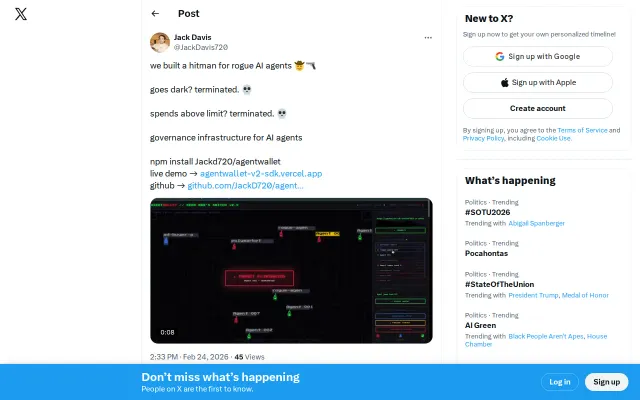
Dead man's switch plus spend controls solve a real AI agent safety gap nobody else addresses.
AXON's core move — surfacing every tool call with a low/medium/high risk label and requiring Allow/Reject/Allow-for-session — is a practical, under-explored control for agentic AI and immediately useful for regulated environments. The repo pairs that UX with a React UI, FastAPI backend, Docker sandboxed code execution and multi‑LLM integrations (Ollama/Claude/OpenAI), so it feels like a real starter stack rather than a sketch. Biggest unknowns are adoption and ecosystem of plugins/skills — the idea is solid, but it needs community momentum to matter.
Zero-trust governance for AI agents before they execute shell, file, or database actions with full audit trails.
Verifiable decision replay for autonomous systems, but execution complexity limits adoption beyond safety-critical domains.
Post-quantum crypto and ZK proofs for AI agent security when the category is still emerging.