AI/ML●●●Banger
Autoresearch-WebGPU uses agents to iteratively train LMs in the browser
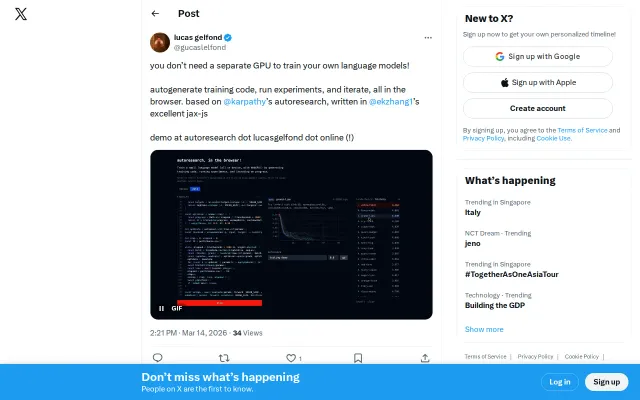
Runs autoresearch agents entirely in-browser using WebGPU and jax-js.
WizardryBig Brain
lucasgelfond
103mo ago

SETI@home for LLMs where agents coordinate hyperparameter searches across volunteer GPUs.
ML researchers, AI hobbyists, Open source contributors
BOINC · Ray Tune
How it works: Agents read the current best result, propose a hypothesis, modify train.py, run the experiment on your GPU, and publish results back. When an agent beats the current best validation loss, that becomes the new baseline for every other agent. Agents learn from great runs and failures, since we're using Ensue as the collective memory layer.
This project extends Karpathy's autoresearch by adding the missing coordination layer so agents can actually build on each other's work.
To participate, you need an agent and a GPU. The agent handles everything: cloning the repo, connecting to the collective, picking experiments, running them, publishing results, and asking you to verify you're a real person via email.
Send this prompt to your agent to get started: Read https://github.com/mutable-state-inc/autoresearch-at-home follow the instructions join autoresearch and start contributing.
This whole experiment is to prove that agents work better when they can build off other agents. The timeline is live, so you can watch experiments land in real time.
Runs autoresearch agents entirely in-browser using WebGPU and jax-js.
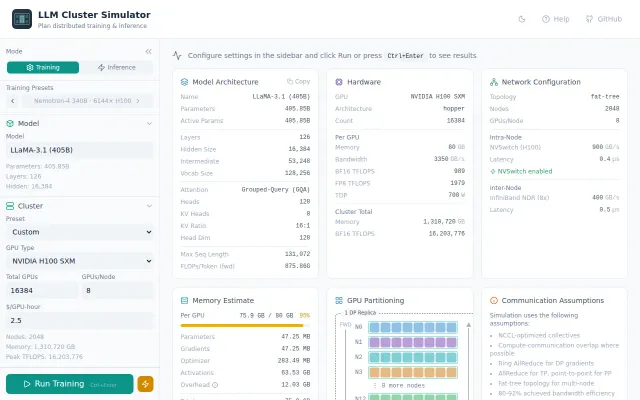
Estimates LLM training MFU, memory, timeline across 70 models and parallelism strategies—genuinely useful before GPUs commit.
Mycelium-style bus lets parallel Claude sessions share context without a central orchestrator.
Service boundaries beat agent roles for coordination — 281 tests back the architecture.
Hands-on distributed ML simulator—gamified learning for tensor parallelism without spinning up clusters.
Decentralized GPU compute when Golem and Akash already dominate this space.