Developer Tools●●Solid
atproxy – proxy Android app TCP traffic to an upstream HTTP proxy
iptables-based transparency beats manual proxy config for stubborn Android apps.
Niche Gem
loncat4215
2026d ago
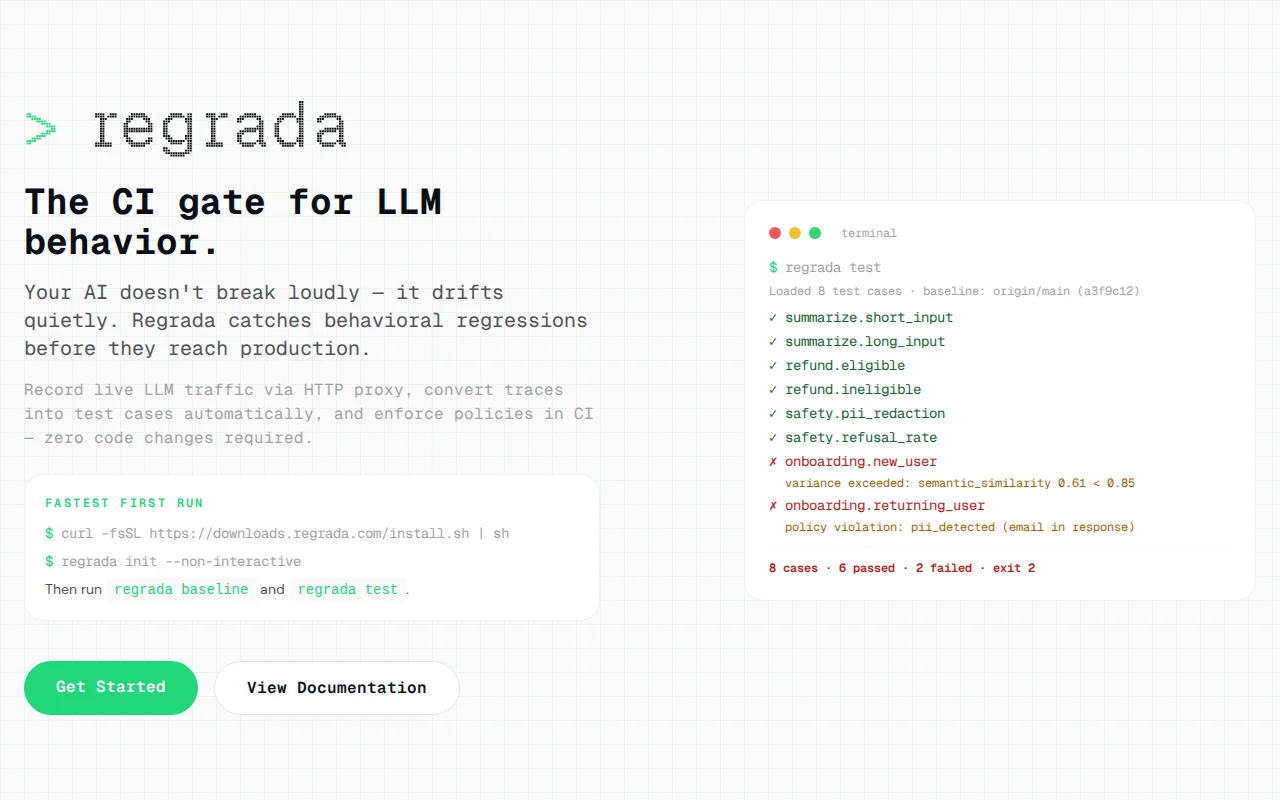
Zero-code proxy capture beats SDK-based eval tools like LangSmith and Arize.
AI/ML engineers building LLM-powered applications
LangSmith · Arize Phoenix · Helicone
Working on LLM-based applications led me to discover 2 big pain points in my opinion:
1. it's difficult to monitor how a prompt change might break behavior. 2. testing SDKs are difficult/high friction to actually integrate and run.
Regrada solves this by intercepting LLM calls, to then build traces and baselines we can compare against and create CI gates to make sure behavior drifts don't reach prod.
Some cool features we've built:
`--explain`: when a case fails after a model change, an LLM helps you detect why the behavior shifted. Not just "assertion failed" but "the model is now truncating before the conclusion clause." Saves a lot of digging to diagnose.
`regrada fuzz`: runs mutations on your inputs (typos, reorderings, edge cases) to find cases where your prompt is more brittle than you think. Caught a production issue for me before launch.
You can run fully local or connect to the cloud runner.
Still pre-launch, actively looking for teams to try it.
Happy to answer questions about how the assertion layer works, the model-agnostic design, or anything else.
iptables-based transparency beats manual proxy config for stubborn Android apps.
Local proxy enforcing markdown rules on LLM output before it hits production.
Browser-based MITM proxy when mitmproxy and Proxyman already dominate this space.
Three UIs (TUI, terminal, web) simplify MitM debugging, but mitmproxy and Burp already own this.
Multi-surface HTTP inspection (CLI, TUI, MCP, API) with project-scoped isolation is thoughtful.
Not a proxy — optimizes Anthropic and OpenAI caching without adding latency or seeing your data.