Developer Tools●●Solid
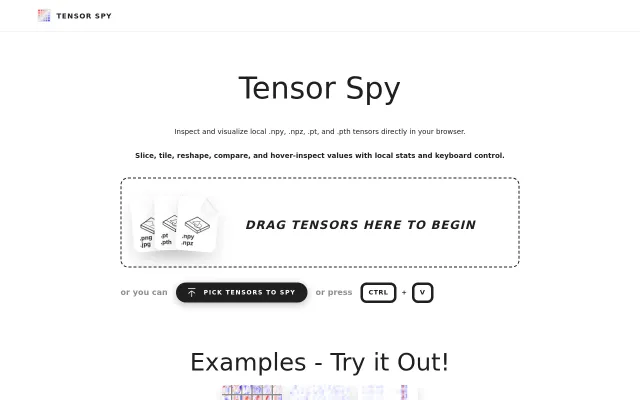
Tensor Spy: inspect NumPy and PyTorch tensors in the browser, no upload
Local tensor visualization beats Jupyter notebooks for quick diffusion latent inspection.
Solve My ProblemEye Candy
jacobn
2213mo ago
let types trickle from runtime to compile time
AST rewriting for runtime types without code changes — why didn't this exist before.
ML engineers, PyTorch developers
Pyright · mypy · pdb
So I built Trickle, it takes the data that flows through your code, caches the types and display them inline (as if you have type annotations).
The idea is: "Let types trickle from runtime into your IDE". You get types in Python without having the write them manually.
It works by rewriting your Python AST at import time — after every variable assignment, it inserts a lightweight call that records the type and value. No decorators, no code changes. Just run your script through trickle run python train.py and every variable gets its type visible.
One cool feature is Error snapshots, by toggling it in VSCode status bar, you can see the exact data that is in each variable when the error happened.
For AI agents, trickle-cli outputs the inline runtime types together with the source code so agent can better diagnose the issue.
For Jupyter notebooks: %load_ext trickle as your first cell, and every cell after is traced.
Quick try: pip install trickle-observe npm install -g trickle-cli code --install-extension yiheinchai.trickle-vscode
trickle run python demo/demo.py trickle hints demo/demo.py
Limitations: - Expect 2-5x slowdown — designed for development, not production.Also supports JavaScript/TypeScript (Express, Fastify, Koa, Hono) though the Python/ML side is where I've focused most effort.
In the future, I imagine there to be potential for using this as runtime observability in production via probabilistic sampling of types. Now, we know the code, we know the data, which is all the information we need to debug.
Happy to answer questions
Local tensor visualization beats Jupyter notebooks for quick diffusion latent inspection.
Two MacBooks syncing gradients over Thunderbolt — slower than single-GPU but it works.
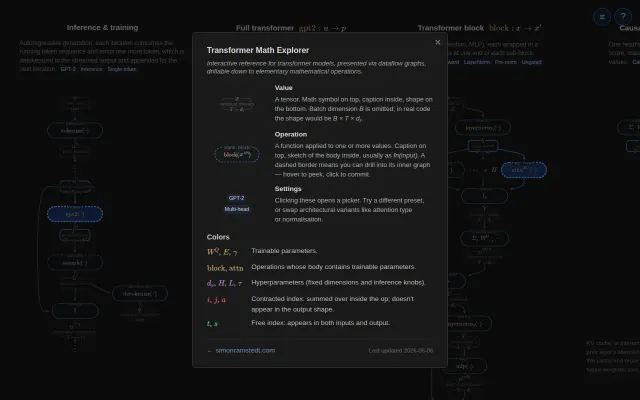
Best interactive transformer visualizer I've seen — finally explains tensor shapes clearly.
LibTorch bindings bring CUDA and MPS backends to Java with LLaMA-3 inference included.
Pure Rust autodiff + GPU math avoids C++ FFI hell, but matmul claim needs apples-to-apples benchmarks.
Takes micrograd's toy autodiff idea and scales it to real tensor operations with NumPy and optional CuPy GPU support. The repo exposes an nn-like module, common activations (ReLU/Softmax), self-attention and an MNIST MLP example, so it's excellent as a learning resource. It's explicitly flagged as WIP — expect performance and OOM rough edges, so treat it as a study tool rather than a training backbone.