Security●●Solid
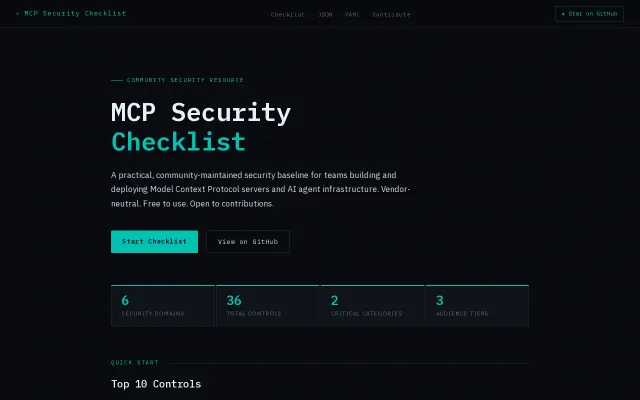
MCP Security Checklist – security controls for MCP server deployments
36 controls across MCP security domains, but is a checklist—not a tool, agent, or enforcement mechanism.
Solve My ProblemCozy
Siri_D
203mo ago
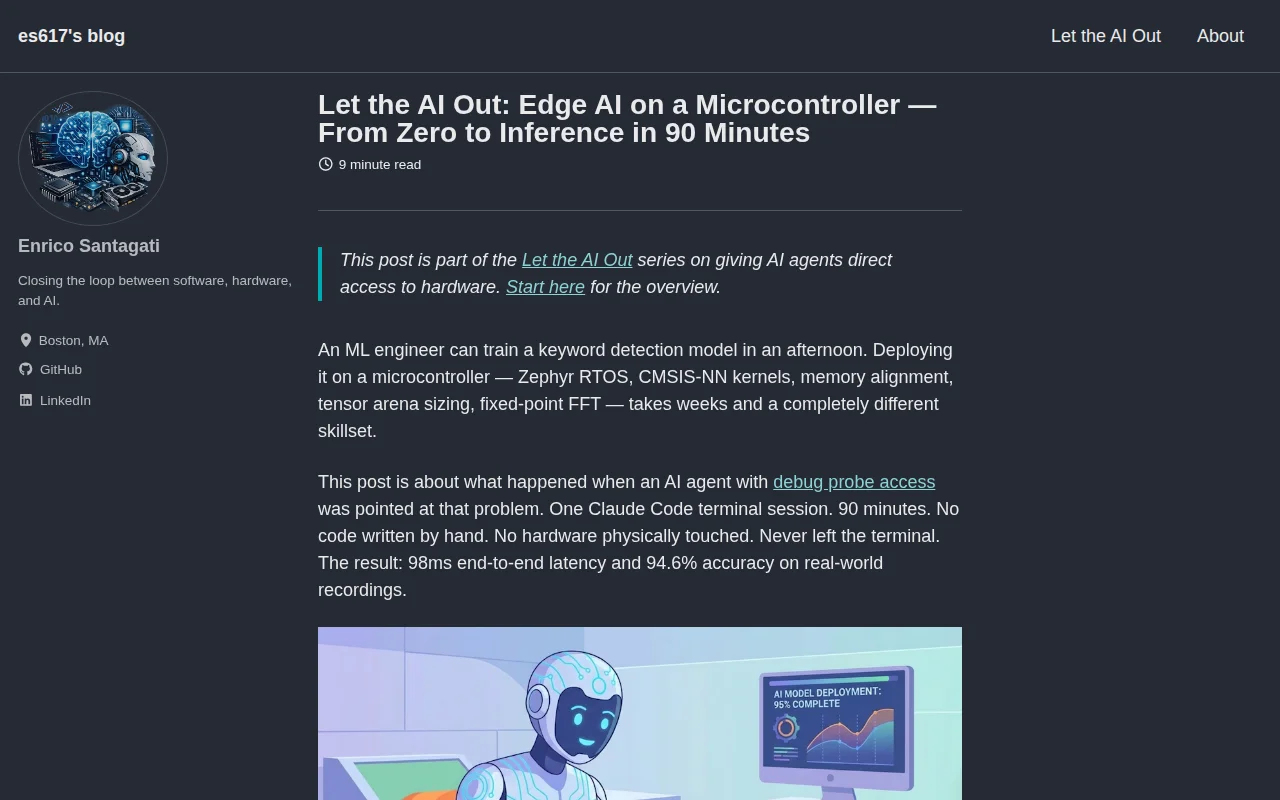
AI agent controls J-Link probes to debug firmware without human intervention.
Embedded engineers, Edge AI developers
Cursor · OpenOCD · Zephyr
This project is about closing that gap. Three MCP servers give the agent direct access to real hardware interfaces: a debug probe (flash firmware, halt CPU, read registers and memory), a serial console (boot logs, CLI commands), and BLE.
Structured tools, not shell commands, so the agent can reason about hardware state the same way it reasons about code.
The latest demo: deploying a TFLite Micro keyword spotting model on an nRF52840 from a single terminal session. The agent flashed firmware, debugged a hard fault, switched to CMSIS-NN optimized kernels, and right-sized the tensor arena.
End result: 98ms end-to-end latency, 94.6% accuracy on real recordings from the Google Speech Commands dataset.
This is part of a broader series on giving AI agents direct access to hardware: https://es617.github.io/let-the-ai-out/
36 controls across MCP security domains, but is a checklist—not a tool, agent, or enforcement mechanism.
C4 diagrams as shared context for AI agents beats prompt drift.
WordPress for MCP servers, but the agent-as-builder vision feels premature.
Remote-hosted MCP server beats local scripts for YouTube transcript access.
Walkthrough mode turns code review into pair programming where the agent points at your screen.
MCP server gives agents visual feedback on 3D designs before handing back to users.