AI/ML●●Solid
Zenflow a multi-agent orchestration and workflow engine
Race-safe mailboxes for agent coordination is a clever specific touch.
Big BrainShip It
vietanh85
201mo ago
An orchestration runtime for multi-agent AI systems. Declare agents, tools, and policies as YAML; Orloj schedules, executes, routes, and governs them for production-grade operation.
Kubernetes for AI agents with YAML manifests and GitOps workflows.
Teams deploying production AI agent systems
LangGraph · CrewAI · AutoGen
We built this because running AI agents in production today looks a lot like running containers before Kubernetes: ad-hoc scripts, no governance, no observability, no standard way to manage the lifecycle of an agent fleet. Everyone we talked to was writing the same messy glue code to wire agents together, and nobody had a good answer for "which agent called which tool, and was it supposed to?"
Orloj treats agents the way infrastructure-as-code treats cloud resources. You write a manifest that declares an agent's model, tools, permissions, and execution limits. You compose agents into directed graphs — pipelines, hierarchies, or swarm loops.
The part we're most excited about is governance. AgentPolicy, AgentRole, and ToolPermission are evaluated inline during execution, before every agent turn and tool call. Instead of prompt instructions that the model might ignore, these policies are a runtime gate. Unauthorized actions fail closed with structured errors and full audit trails. You can set token budgets per run, whitelist models, block specific tools, and scope policies to individual agent systems.
For reliability, we built lease-based task ownership (so crashed workers don't leave orphan tasks), capped exponential retry with jitter, idempotent replay, and dead-letter handling. The scheduler supports cron triggers and webhook-driven task creation.
The architecture is a server/worker split. orlojd hosts the API, resource store (in-memory for dev, Postgres for production), and task scheduler. orlojworker instances claim and execute tasks, route model requests through a gateway (OpenAI, Anthropic, Ollama, etc.), and run tools in configurable isolation — direct, sandboxed, container, or WASM. For local development, you can run everything in a single process with orlojd --embedded-worker --storage-backend=memory.
Tool isolation was important to us. A web search tool probably doesn't need sandboxing, but a code execution tool should run in a container with no network, a read-only filesystem, and a memory cap. You configure this per tool based on risk level, and the runtime enforces it.
We also added native MCP support. You register an MCP server (stdio or HTTP), Orloj auto-discovers its tools, and they become first-class resources with governance applied. So you can connect something like the GitHub MCP server and still have policy enforcement over what agents are allowed to do with it.
Three starter blueprints are included (pipeline, hierarchical, swarm-loop).
Docs: https://docs.orloj.dev
We're also building out starter templates for operational workflows where governance really matters. First on the roadmap: 1. Incident response triage, 2. Compliance evidence collector, 3. CVE investigation pipeline, and 4. Secret rotation auditor. We have 20 templates in mind and community contributions are welcome.
We're a small team and this is v0.1.0, so there's a lot still on the roadmap — hosted cloud, compliance packaging, and more. But the full runtime is open source today and we'd love feedback on what we've built so far. What would you use this for? What's missing?
Race-safe mailboxes for agent coordination is a clever specific touch.
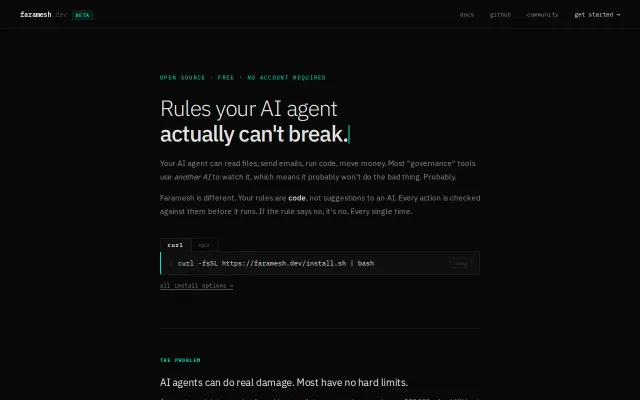
Code-based rules beat AI monitoring AI for actual enforcement guarantees.
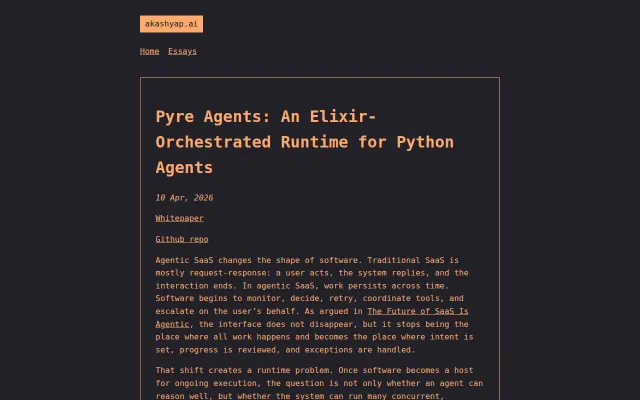
Uses Elixir OTP to orchestrate Python agents with 3.77 KB memory overhead.
Declarative YAML turns any REST API into an MCP tool in minutes.
MCP integration lets agents draft Pulumi changes without ever touching prod credentials.
Enterprise agent orchestration with governance, but YAML + policies aren't novel.