AI/ML●●Solid
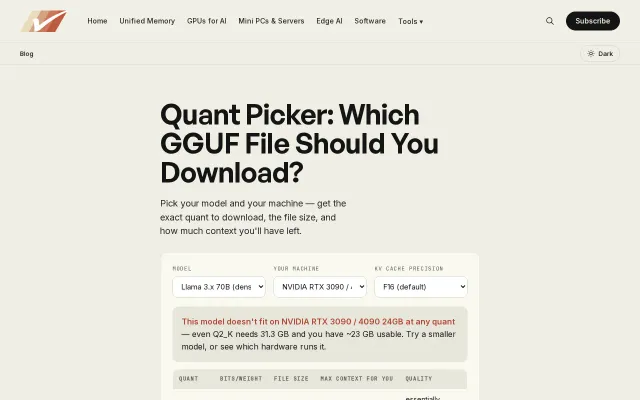
Quant Picker – which GGUF file fits your model and machine
Finally answers the GGUF quant question everyone asks in Discord.
Solve My ProblemNiche Gem
ermantrout
1801d ago
AI-native OS kernel written from scratch in C and x86_64/aarch64 assembly — kernel-level tensor compute, capability-based security, SMP, TCP/IP, and 95 userland programs
Custom GGUF parser with mmap beats llama.cpp load times, but zero stars means unproven claims.
ML engineers running large models on consumer hardware
llama.cpp · ollama · MLX
*What it does:* - Mixtral 8x22B (80GB, 141B params) runs on a machine with 48GB RAM - Model loads in 0.3 seconds (vs 190s with llama.cpp) - Produces correct output: "What is 2+2?" → "The sum of 2 and 2 is 4." - Zero dependencies — custom tensor engine, custom GGUF parser, no ggml/llama.cpp
*How it works:* - `mmap()` the GGUF file. The OS handles SSD→RAM paging transparently - Quantize the input to Q8_K, compute dot products directly against Q4_K/Q5_K/Q6_K weights in the quantized domain — no dequantization to float32 - AVX2 SIMD + 8-thread parallel matvec - For MoE models: only 2 of 8 experts are active per token, so most weights stay cold on disk
*The hard part we solved:* GGUF models are calibrated for a specific dot product computation path (ggml's "quantize input → integer multiply-accumulate → late float conversion"). If you naively dequantize weights to float32 and do a standard dot product, the per-operation error is tiny (~0.001%) but compounds across 56 transformer layers into completely wrong output. We had to reverse-engineer and match ggml's exact scalar computation — block-level integer accumulation with 8-lane parallel reduction — to get correct results.
*What it doesn't do (yet):* - Speed: ~0.08 tok/s on the 80GB model (CPU-only, no GPU offload) - No interactive chat UI - Only K-quant GGUF formats (Q4_K_M, Q5_K_M, Q6_K — covers ~90% of models on HuggingFace) - Windows only (Linux stubs exist but untested)
The architecture comes from my "work in progress" WayOS (https://github.com/cloudlinqed/WayOS), an AI-first OS that treats SSD/RAM/VRAM as a unified memory hierarchy.
Finally answers the GGUF quant question everyone asks in Discord.
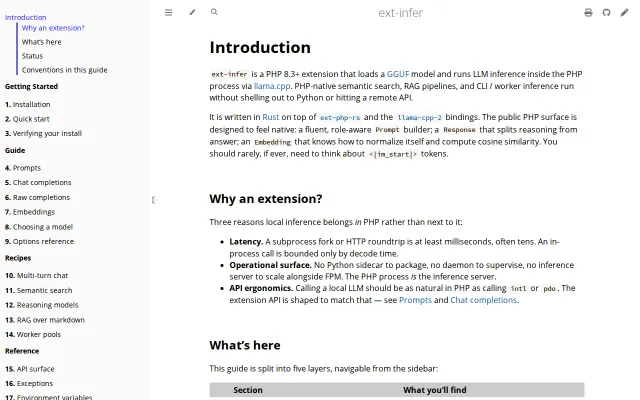
In-process LLM inference in PHP beats the usual Python sidecar pattern.
Native ternary training beats post-training quantization for memory efficiency.
Pure Go LLM inference, zero dependencies, 48 tok/s—genuinely novel for Go ecosystem.
3.9s cold starts vs 45s+ for quantized models—real infra pain solved tangibly.
Ollama and llama.cpp server already do this with more maturity and model support.