Developer Tools●●●Banger
L6e – Give your Agent a budget (save tokens, get smarter results)
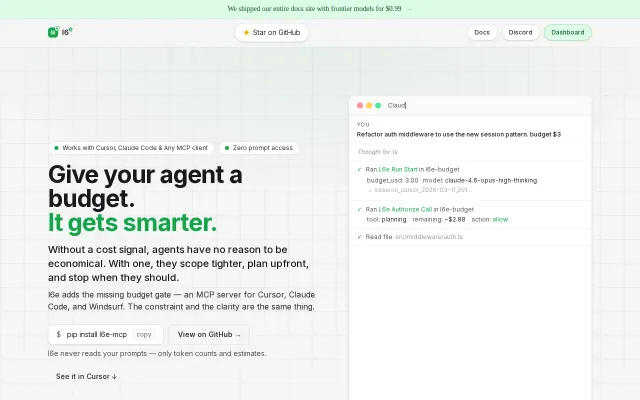
MCP server budgets token spending, making agents plan tighter and stop when done.
Big BrainSolve My Problem
bennettdixon
662mo ago
Token budget enforcement for AI agents. Hard limits, configurable policy, zero infrastructure required.
Tracks tokens not dollars—clever design that avoids pricing drift headaches.
Developers building AI agents with LangChain, CrewAI, or direct API clients
Helicone · LangSmith · Portkey
Two ways to add it:
# Direct client wrapper client = tokencap.wrap(anthropic.Anthropic(), limit=50_000)
# LangChain, CrewAI, AutoGen, etc. tokencap.patch(limit=50_000)
Four actions at configurable thresholds: WARN, DEGRADE (transparent model swap), BLOCK, and WEBHOOK. SQLite out of the box, Redis for multi-agent setups.One design decision worth mentioning: tokencap tracks tokens, not dollars. Token counts come directly from the provider response and never drift with pricing changes.
Happy to answer any questions.
MCP server budgets token spending, making agents plan tighter and stop when done.
Macaroon-based budget enforcement for AI agents—fills a real economic governance gap.
Real-time dollar limits on AI agents, monkey-patched into OpenAI/Anthropic SDKs.
VERONICA puts an enforcement shim between your agent and the model so you can halt costly spirals before a request hits the provider — it natively exposes hard budget enforcement, circuit breakers, retry containment and degradation levels. The README + runnable runaway-loop demo make the failure mode concrete and the API (BudgetEnforcer, RuntimeContext, BudgetExceeded) is small and practical. I'd like to see richer observability/adapter docs for common agent frameworks, but as an enforcement-first primitive this is a clever, useful tool.
Pre-execution budget reservation stops runaway agents before they burn $200.
Reserve-before-execute budget protocol prevents agents from burning money unexpectedly.