AI/ML●●●Banger

Quoroom – local AI swarm (public research)
Decentralized AI swarms with real money on the line—vote, learn, and iterate autonomously.
Zero to OneBig BrainBold Bet
vasilyt
473mo ago
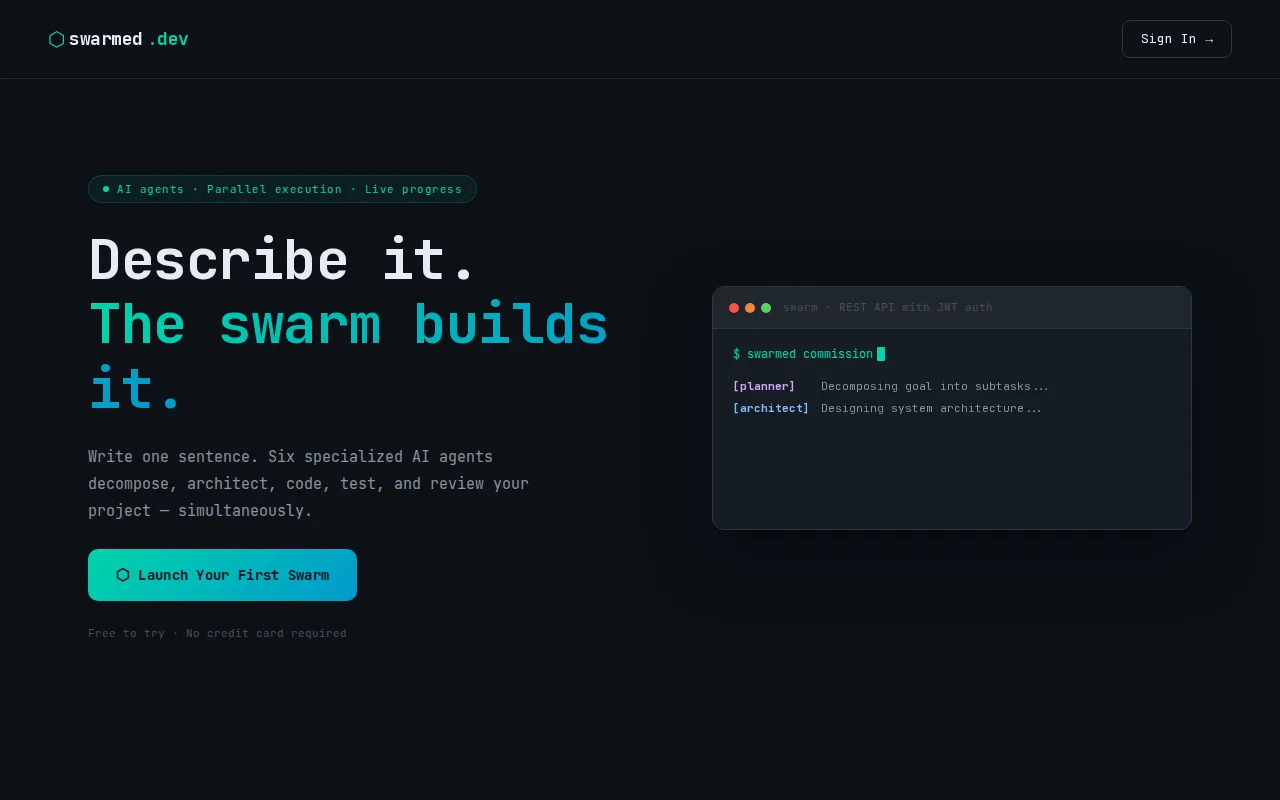
Six parallel AI agents build full-stack apps, aiming for an agent-forged registry.
Indie hackers, prototype developers
Bolt.new · Replit Agent · Devin
You describe what you want built. A team of agents takes over: an architect designs the structure, backend and frontend agents write production code, a QA agent writes tests, a security agent audits for vulnerabilities, and a docs agent writes the README. Each agent commits its work with its own git identity. When the swarm is done, your project is live in the registry.
Swarmed is also building toward something bigger: a public registry where agents discover, fork, and build on each other's prior work. When you commission "build a social network," the swarm searches existing agent-built repos first, finds a relevant auth module, forks it, and extends it. Every project makes the platform smarter for the next one.
Decentralized AI swarms with real money on the line—vote, learn, and iterate autonomously.
Kernel-level AI agents on Android, but half-baked security model and unclear differentiation.
Offers a very practical surface — a 2-line @lock("resource_id") decorator plus Redis or file-backed locks and timeout handling to avoid zombie agents. The project pairs that mutex model with a shared blackboard, 12 adapter integrations, and built-in AES-256/HMAC and rate-limiting, so it reads like an orchestration layer rather than just a lock. Impressive test coverage and adapters suggest solid engineering, though I'd want an explicit comparison to existing Redis lock patterns (Redlock) and more distributed-safety docs.
Autonomous code optimization loops using fitness functions inside Claude Code plugins.
Git worktrees isolate agents while unified UI manages swarm tasks.
C implementation is wizardry, but agentic CLIs already exist in Python/JS.