Developer Tools●●Solid
MemoryKit – Persistent memory layer for AI agents
Three-method API for agent memory, but semantic memory systems aren't novel anymore.
Solve My ProblemShip It
memorykit
303mo ago
🚀 The Agentic Memory Layer & Universal Retrieval Toolkit. Synthetic data generation, 15+ vector backends, hybrid search, and MCP native memory for AI agents.
MCP-native memory with synthetic data generation for AI agent retrieval workflows.
AI agent developers, ML engineers building retrieval systems
LangChain · LlamaIndex · Mem0
Three-method API for agent memory, but semantic memory systems aren't novel anymore.
Swapping global vector scans for O(k) prefix/deterministic retrieval is a clever pivot that could cut latency and cost for local agent memory. The repo ships a usable Windows binary plus an MIT Python SDK and LangChain-friendly badges — enough to test the claim quickly — but the core engine is proprietary and lacks reproducible benchmarks, so you’ll want evidence before trusting it at scale.
Putting the memory layer on-disk as a .afs/ tree is a gutsy, practical move — you get searchable JSON, FTS5 for text queries, HNSW vectors for similarity, and msgpack edges for relationships without running a separate DB service. It feels like a thoughtful toolkit for agents that must persist thinking artifacts (observations → reflections → knowledge), though I want to see details on concurrency, index portability, and how this performs at scale before betting production workloads on it.
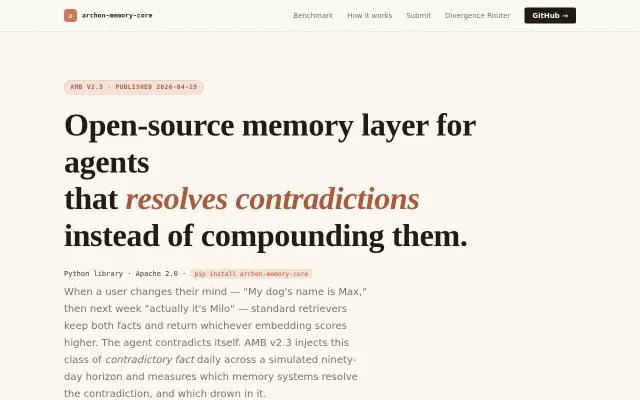
Resolves agent memory contradictions instead of compounding them like standard retrievers.
Explainable retrieval with decision traces beats Mem0 and Zep on transparency.
NER+PageRank graph memory beats vectors on speed, but GraphRAG and Mem0 already handle multi-hop reasoning.