Developer Tools●●Solid
V-COS – Governance layer that keeps AI coding agents coherent
Governance layer for AI agents when Cursor rules and memory banks fail.
Solve My ProblemBig Brain
vagnerfirmino
202d ago
Stops AI agents from forgetting requirements by writing decisions to locked files.
Developers using AI coding agents
Cursor · GitHub Copilot Workspace · Aider
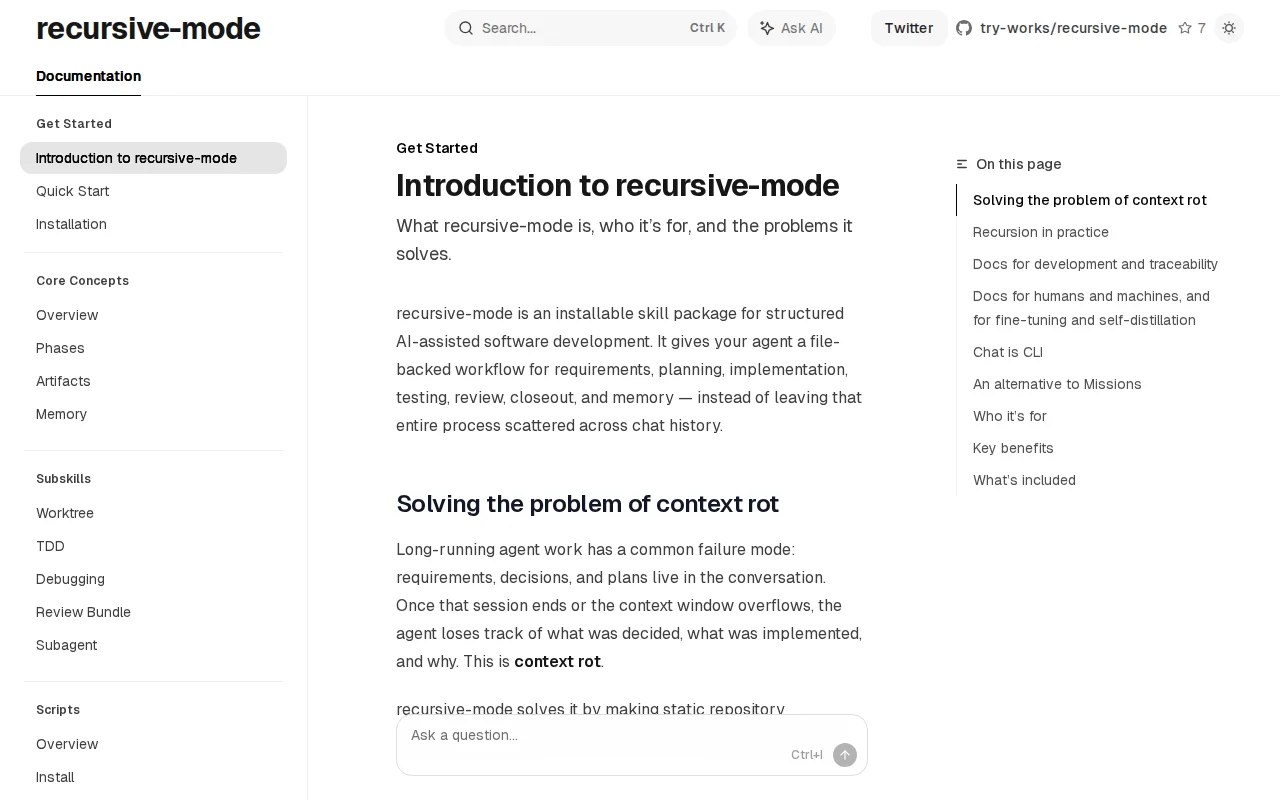
Long-running agent work has a common failure mode: requirements, decisions, and plans live in the conversation. Once the session ends or the context window overflows, the agent loses track of what was decided, what was implemented, and why.
recursive-mode solves context rot by making repository documents the source of truth for every phase. Requirements, plans, evidence, state, and decisions live in files that persist across sessions, contributors, and repositories. Prompts become short commands, not full specs.
The workflow is built on a few simple rules. Each development phase produces one locked output document. Each phase uses earlier phase outputs as input. Before the agent can exit a phase and move forward, it must satisfy defined criteria based on the workflow and prior docs.
It is called recursive-mode because the workflow keeps revisiting its own outputs. Later phases consume earlier artifacts. Audited phases loop through draft, audit, repair, and re-audit until the work is actually ready. Closeout feeds validated lessons back into decisions, state.
The generated docs are both human-readable and machine-readable. They give strong traceability for what was built, why it was built that way, what changed, and how it was validated. Instead of reconstructing rationale from chat logs, you can point directly to the repo artifacts.
That also makes recursive-mode useful beyond day-to-day development. The run docs, together with code diffs in the worktrees, form a high-quality dataset for fine-tuning, auto-training, or self-distillation against your own codebase and engineering process.
Chat is treated more like a CLI. You use it for commands, not as the place where critical project knowledge lives. You can refine a plan with the agent, ask it to turn that plan into a new recursive run, or create the run folder and requirements doc yourself, and tell the agent to "implement run 01" to start the run.
recursive-mode is a free open source alternative to Missions. It is for developers and teams who want auditable agent runs, recorded evidence, and long or resumable work that can continue without losing context.
Installation:
npx skills add try-works/recursive-mode --skill '*' --full-depth
skills.sh:
https://skills.sh/try-works/recursive-mode/recursive-mode
GitHub:
https://github.com/try-works/recursive-mode
For detailed documentation:
Write-up with benchmark:
Governance layer for AI agents when Cursor rules and memory banks fail.
Prevents Claude context collapse via 3-hook rotation pipeline—ambitious but production setup is heavyweight.
Markdown files as persistent memory solve AI agent context rot.
Maps Git worktrees to AI tasks to stop context decay in VS Code.
Relay architecture beats context rot, but depends entirely on Claude Code CLI for now.
Recursive review cycles force agent confidence scores before you ever see the output.