Data●●Solid
Kanoniv – Identity resolution in 170 lines of YAML Built in Rust
YAML-driven record linkage beats hand-rolled SQL, but Splink already solved this.
Niche GemShip ItSolve My Problem
dreynow
104mo ago
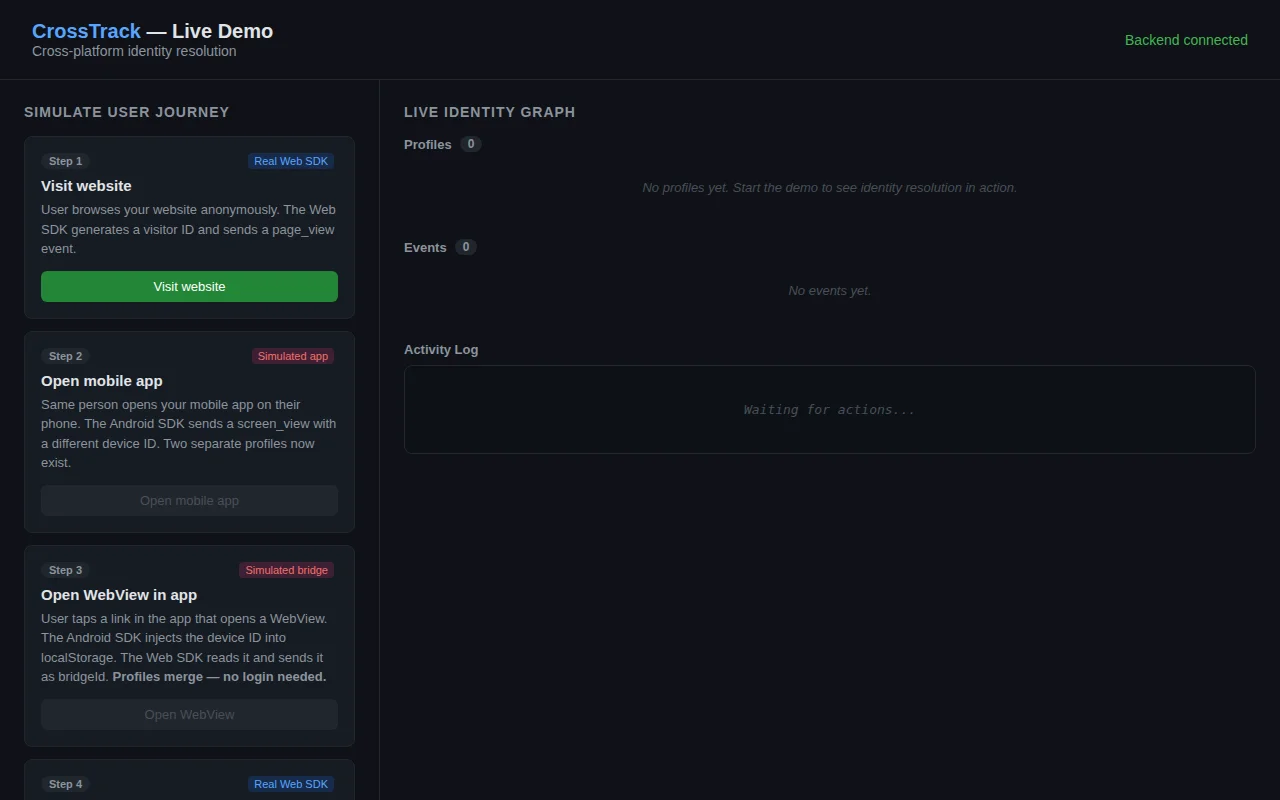
WebView localStorage bridge links app and web sessions without login.
Growth engineers, analytics teams, mobile developers with companion web apps
Segment · RudderStack · mParticle
The problem: if you have an app and a website, the same person shows up as 2-4 different "users" in your analytics. Your user counts are inflated, your funnels are broken, and you're retargeting people who already converted.
I built SDKs (Web, Android, iOS) that handle this server-side. The bit I'm most proud of is a WebView bridge — when someone opens a link in your app's in-app browser, the SDKs silently link the sessions without needing a login.
Live demo: https://crosstrack-demo.onrender.com
Is this a problem you've actually hit? Curious what you'd need to try something like this.
YAML-driven record linkage beats hand-rolled SQL, but Splink already solved this.
Auth0 for AI agents, but the premise assumes a problem that doesn't yet exist.
The SDK exposes the exact primitives you want for autonomous-agent commerce: register/resolve identity, attest and badge verification, create/fund/cancel escrows, release/slash settlements, and reputation queries — plus event hooks. It's a smart, timely idea to stitch payments and trust into agent URIs, but the repo still reads like an early SDK: docs and integration examples are thin and there's no clear public security/settlement audit or adoption evidence yet.
OAuth-equivalent for agents: cryptographic identity, scoped grants, audit trail.
Zero trust security for AI agents fills the MCP identity gap before competitors do.
Delegation chains with accumulating caveats narrow authority at each agent hop.