Developer Tools●Mid
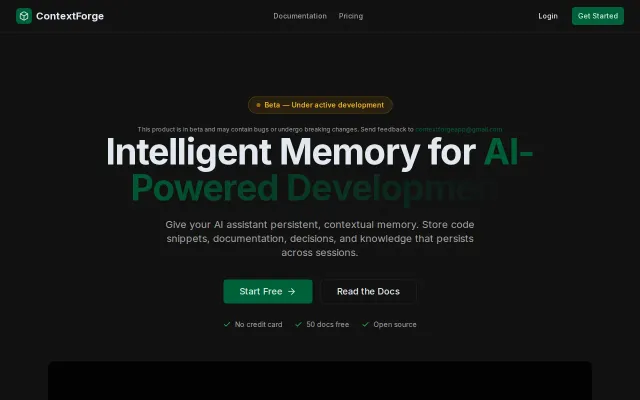
ContextForge – Persistent memory MCP server for Claude
Claude memory is solved—Pinecone, LLamaIndex, and Continue already do this.
Ship It
alfredoizjr
283mo ago
Shared intelligence layer for organizations
Git-backed shared memory solves AI team context drift better than vector DB wrappers.
Engineering teams using Claude Code
Cursor · Continue · Obsidian
we were essentially working on dynamic ontology systems (how to organize unstructured data given context / starting conditions dynamically). since december new capabilities that came around with opus 4.5 completely altered the nature of our work. but despite the radical increase in speed and ambition of our experiments, we were visibly diverging from a common vision. once we acknowledged that together, we decided to find ways to infrastructure mechanisms for convergence. first it was integrating the GitHub organization and repos we are working on, later we developed custom commands that would help us share research, request code reviews and even send each other spam through a tg connector we built for notifications :)
https://imgur.com/a/egregore-telegram-notification-LM0ldPV
we then realized we can integrate the agentic knowledge graph infrastructure we were building for the dynamic ontology research. our stack emerged very rapidly and one week in it was glaringly obvious that we should stop everything and get to working exclusively on this. the speed of accumulation of multi-agent context coupled with frontier model capabilities yielded wow moments one after another. for two months we implemented key features and improved core functionalities.
given our background in organization design and distributed systems, we knew that this was a primitive that should be spread widely and experimented with since there is no single good answer to how an organization should be designed. but it was clear to us that using agent harness form factor as an organization design substrate is incredibly promising given: speed of context accumulation, the continuity (handoffs) it enables between individuals and adaptability of the organization to changing (internal and external) conditions.
anyway, after couple months of wow-ing to our own creation we knew we had to get this out and face the moment of truth whether: we actually built something interesting or we are getting high off our own supply. so thats what we are doing today: we created a version of egregore — slash commands, git-backed markdown memory, Claude Code hooks — that is self-hosted and without dependencies (no knowledge graph etc) so that we can release it as a viable open-source primitive anyone can use and mutate according to their needs with their friends and colleagues.
what you can do with it today:
- `/invite` — onboard a teammate with the full accumulated context already in place - `/handoff` — pass a session on with reasoning and context preserved. the next person, future-you, or their agent picks up the thread without restarting - `/activity` — see what the team has actually been doing, synthesized from real sessions - `/deep-reflect` — cross-reference an insight against the organization's full memory - `/view` — render a shareable artifact from any slice of what the team knows
excited to have you all try, and get your feedback.
Claude memory is solved—Pinecone, LLamaIndex, and Continue already do this.
Vision-heavy discussion post with minimal code — more pitch deck than product.
Mimir hooks into Claude Code lifecycle events so agents can 'mark' facts (e.g., "API uses snake_case") into a DuckDB-backed memory and RAG pipeline, then auto-injects that context as additionalContext for later agents. It's a pragmatic, well-scoped solution to the annoying problem of agent amnesia — very useful if you run agent swarms, but its impact is limited by Claude Code adoption and the need for the surrounding infra (BGE keys, hooks).
AI memory layer when mem0 and LangMem already own this category.
Local memory for AI agents that actually learns from your last 50 sessions, not just context window tricks.
Persistent memory for Claude across sessions, but API stability unclear at v0.3.0 beta.