Developer Tools●●Solid
Pviz-parser – codebase parsing package for Python and TS/JS codebases
Compressed JSON bundles fit tight context windows better than pasting files.
Big BrainNiche Gem
pvizgenerator
1021d ago
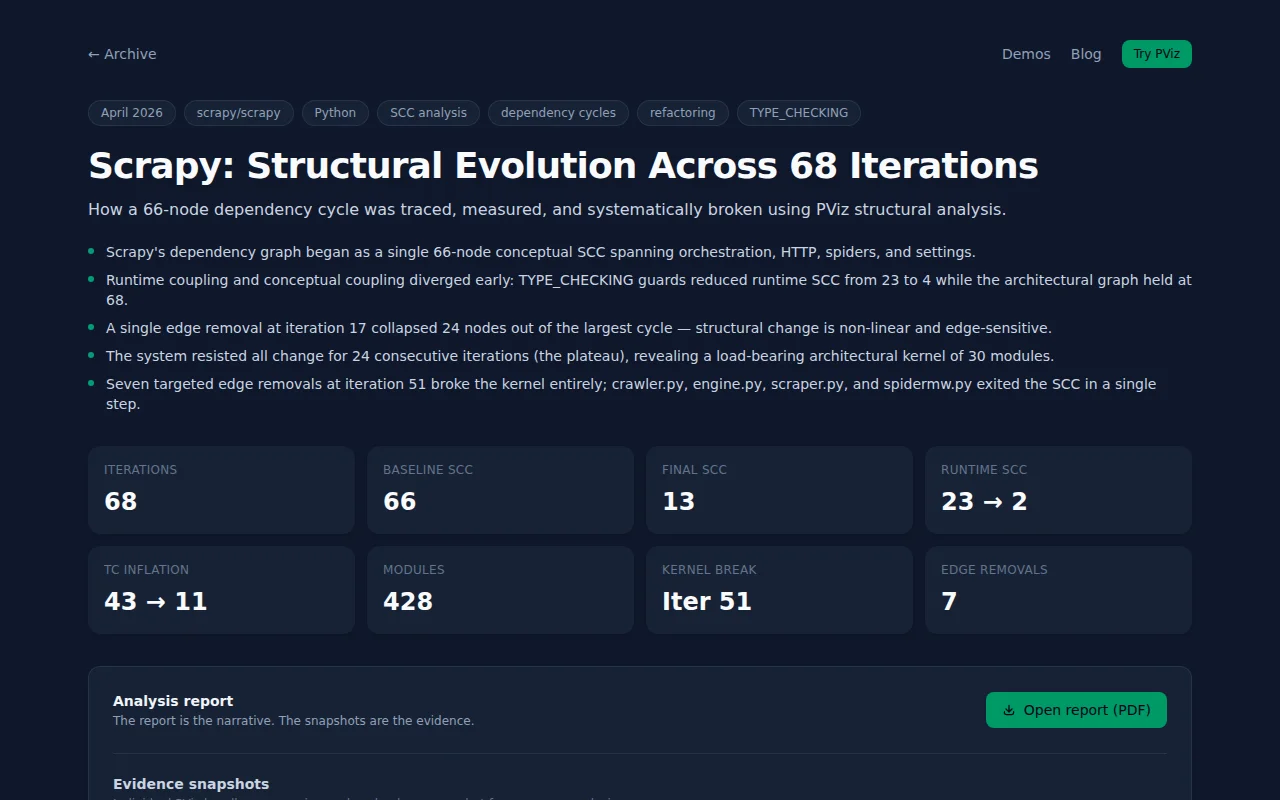
Dependency cycle analysis with iteration snapshots shows non-linear structural change patterns.
Maintainers of large Python codebases dealing with dependency cycles
pyan · pydeps · CodeGraph
To put it through its paces, I ran it on Scrapy with a concrete goal: reduce SCCs without changing runtime behavior.
Starting point → Final result: - Largest conceptual (TYPE_CHECKING-masked) SCC: 66 → 15 nodes - Runtime SCC: 23 → 2 nodes
Going in with no prior knowledge of the codebase, the refactor took 68 iterations and surfaced some non-obvious structural behaviors:
- Runtime coupling collapsed early (23 → 4 by iteration 17) while the conceptual graph stayed largely intact — suggesting runtime and conceptual coupling respond to different kinds of changes - A ~24 iteration plateau (iterations 27–50) where the conceptual SCC held at 30 nodes, indicating a load-bearing architectural core that couldn’t be decomposed incrementally - A “kernel break” at iteration 51 where the crawler, engine, scraper, and spider middleware all exited the SCC in a single step — nonlinear progress after a long stall - A deliberate regression at the end (13 → 15): HTTP-layer coupling was identified as structurally necessary during testing and reinstated
The full progression is documented through curated dependency snapshots across key iterations, along with test logs, a detailed analysis report, and compressed analysis bundles.
Happy to discuss if you find this interesting.
Compressed JSON bundles fit tight context windows better than pasting files.
Cuts Claude coding tokens 58% via dependency graphs; runs local, no cloud, no account.
Replaces vector RAG with dependency graphs; 89% fewer tokens but benchmark setup is contrived.
Privacy-first cycle tracker you fully control, but the category already has established players.
Structured traces beat asciinema for debugging — machine-readable, not video.
MCP query server cuts codebase context by 87% with zero dependencies, measured.