Security●●●Banger
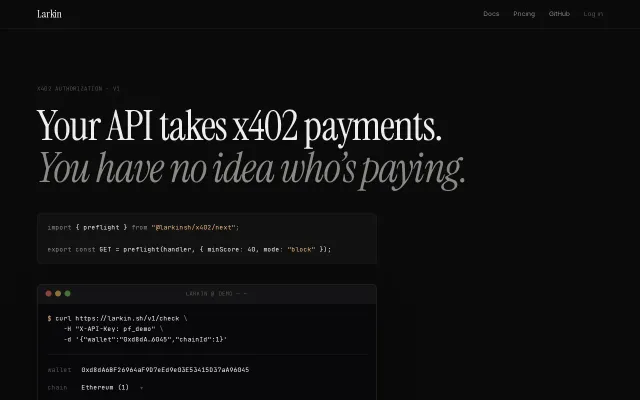
Larkin – Authorization middleware for x402 agent payments
Solves agent authorization for x402 payments with verifiable Ed25519 receipts.
Bold BetBig Brain
mikebom
101mo ago
ZK proofs inside x402 headers solve the anonymous wallet problem for AI agents.
Backend developers building agentic payment systems
Lemma · x402 · EIP-3009
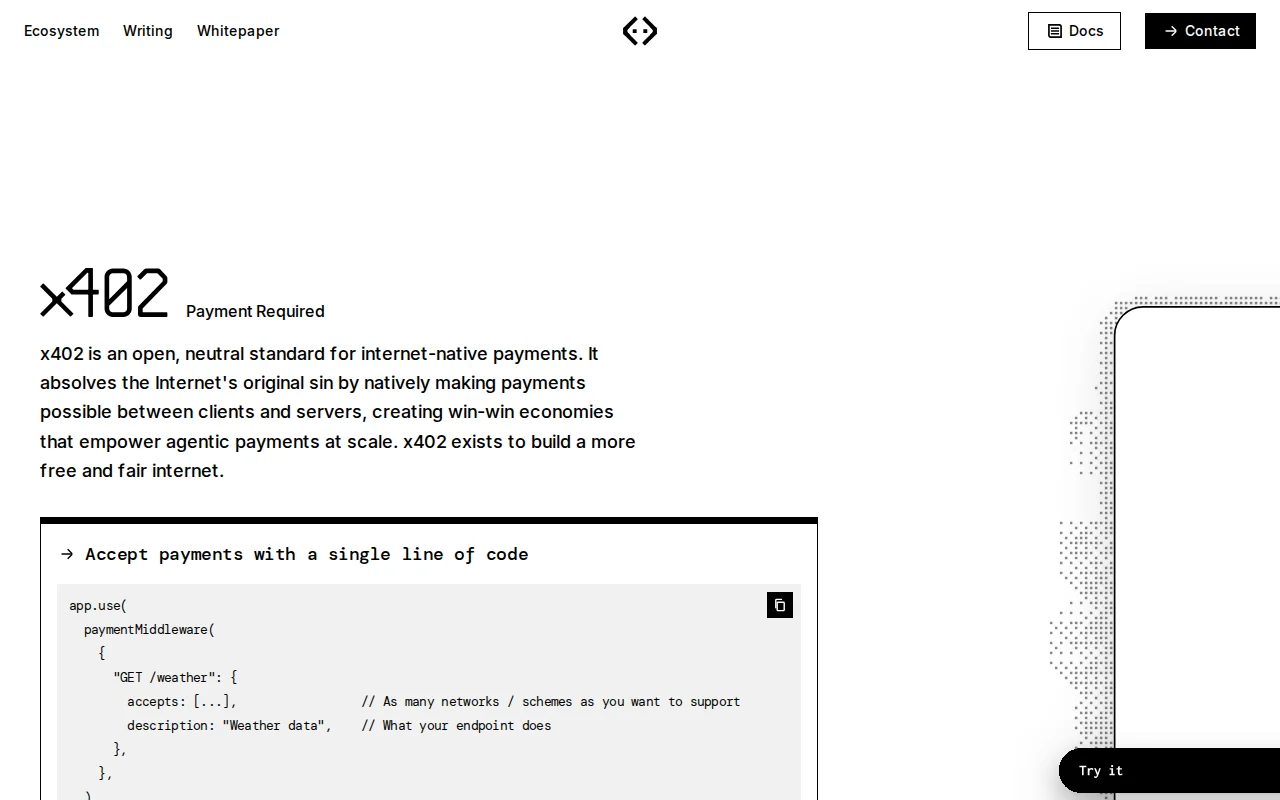
(Recap: x402 is Coinbase's revival of HTTP 402. Server returns 402, client signs an EIP-3009 USDC auth on Base, retries with PAYMENT-SIGNATURE, facilitator settles. Spec: https://x402.org)
I'm the CTO of FRAME00. We've been building Lemma, a document oracle that binds ZK attribute proofs to on-chain Merkle commitments. Three weeks ago I started asking whether the same proof bundle could ride inside an x402 round trip instead of a separate verification step. This repo is the answer.
The gap x402 leaves: the server gets a wallet address and a tx hash. It doesn't know who authorized the payment, under what policy, or whether the data arrives intact. As agents become the payer, a wallet address is an anonymous primitive, not a principal.
What this adds to the x402 flow:
Phase 1 Agent hits any x402-protected endpoint with @x402/fetch. -> standard 402 with accepts[]. Nothing Lemma-specific. Phase 2 Wallet signs EIP-3009 USDC auth, retries with PAYMENT-SIGNATURE, facilitator settles. -> PAYMENT-RESPONSE carries extensions.lemma = { proof, inputs, circuitId, generatedAt }. A registered x402 extension, not a sidecar. Phase 3 Agent checks SHA-256(body) against attributes.integrity in the proof. No round trip. Phase 4 POST /query for BBS+ selective disclosure. Released only when the caller's x402 payment satisfies condition.circuitId = "x402-payment-v1" -- today this is API-level access gating; the binding is moving into the BBS+ challenge itself (see below).
The demo wraps Phase 1 in a free GET /article returning an X-Lemma-Attestation header pointing at /verify/:hash. Point @x402/fetch at any paid resource directly and Phase 1 is just standard 402.Server side is a drop-in for @x402/hono:
import { paymentMiddleware, x402ResourceServer, ExactEvmScheme } from "@lemmaoracle/x402";
const server = new x402ResourceServer(facilitatorClient) .register("eip155:84532", new ExactEvmScheme()); app.use("*", paymentMiddleware(routes, server));
paymentMiddleware auto-attaches a hook that writes extensions.lemma into PAYMENT-RESPONSE. Route handlers don't change.Agent side uses stock @x402/fetch; no Lemma SDK on the client:
const x402Fetch = wrapFetchWithPayment(fetch, client); const res = await x402Fetch(`${WORKER_URL}/example/verify/${hash}`); const settle = JSON.parse(atob(res.headers.get("PAYMENT-RESPONSE"))); // settle.extensions.lemma = { proof, inputs, circuitId }
What this doesn't claim:* Data source is not on-chain. We bind SHA-256 of the body to a chain commitment; not authorship. * The issuer's BBS+ key is the trust anchor. Identity, settlement, and integrity proofs are independent. * Facilitator is a liveness dependency (x402 design). Fail-closed. Swap or self-host any x402-compatible one.
What is shipping next:* Agent-side identity. did:key -> agentId with role, scope, spendLimit. Lifts the paying wallet from anonymous primitive to verifiable principal. * Cryptographic settlement binding. Today condition.circuitId is enforced at the API layer; the BBS+ proof itself verifies offline once obtained. We are folding the x402 settlement record into the BBS+ challenge so re-use without a fresh payment becomes infeasible at the proof layer.
Both are on-axis with the thesis: payment is the trigger; verifiable trust rides on top.Repo: https://github.com/lemmaoracle/example-x402 x402 SDK: https://www.npmjs.com/package/@lemmaoracle/x402 Lemma SDK: https://www.npmjs.com/package/@lemmaoracle/sdk
Questions on the circuit layer, BBS+ binding, or DID roadmap welcome.
Solves agent authorization for x402 payments with verifiable Ed25519 receipts.
x402 middleware for REST APIs, but agent payments are still niche and early.
HTTP 402 finally has a real use case: pay-per-file via gasless USDC transfers.
x402 micropayments for articles when Medium and Substack dominate with subscriptions.
Solves payment-to-job race conditions, but bets on an agent economy that doesn't exist.
x402 payments are novel but Durable and 10Web already do AI websites better.