Social●●Solid
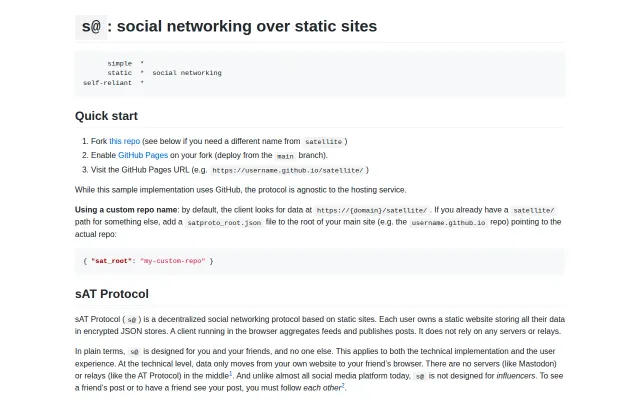
SAT Protocol – static social networking
Host encrypted social feeds on static sites without servers or relays.
Big BrainBold Bet
remywang
313mo ago
Proof-of-work Sybil resistance without central gatekeepers actually works.
Developers building decentralized apps, privacy advocates, Mastodon/Nostr users
Nostr · Mastodon · Bluesky
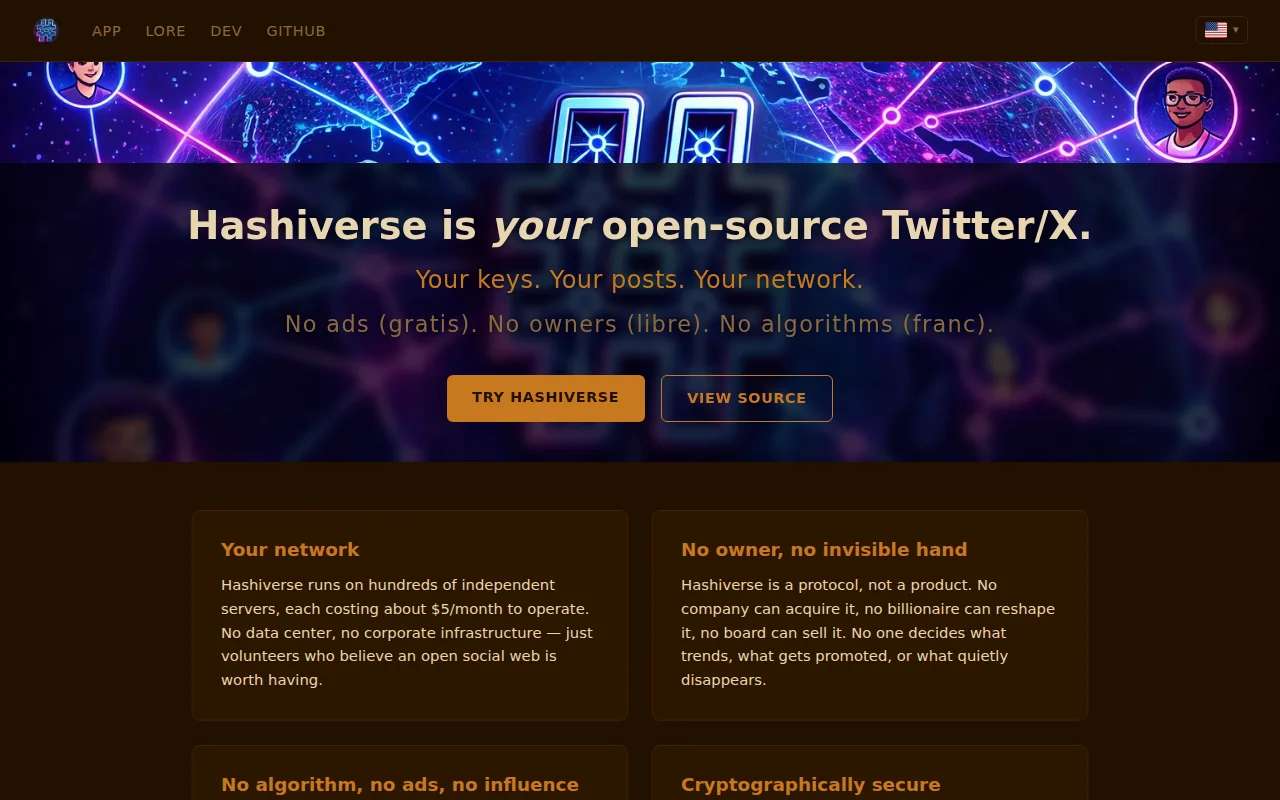
Hashiverse (https://github.com/hashiverse/hashiverse) is an open-source decentralized social network protocol where Sybil resistance, rate limiting, peer reputation, and content moderation all fall out of one design choice: every action carries a proof-of-work cost calibrated to how much abuse it could cause. No central servers, no DNS dependency, no registration authority, no moderation team. Rust core, WASM browser client, volunteers on $5 VPS machines.
Twitter-shaped (posts, follows, hashtags, timelines). The design problem that usually kills these projects on day one is Sybil resistance without a gatekeeper, so that is what I most want feedback on. Signatures and encryption are conventional (ed25519 + ML-DSA + FN-DSA, ChaCha20Poly1305, Blake3). The interesting surface is how every protocol action is priced in proof-of-work calibrated to its abuse potential.
Shared primitive: a data-dependent chain over 17 hash algorithms. 5 rounds, each selecting one of 17 algorithms (Blake2s/b, SHA-2/3 at 256/384/512, Keccak-256/384/512, Groestl-256/512, Whirlpool, Skein-256/512, Blake3) and applying it 1 or 2 times. The algorithm index and repetition count for round N come from bytes of round N-1's output, so dispatch is data-dependent and only resolved at runtime.
Honest prior art: Evan Duffield's X11 (Dash, 2014) chained 11 SHA-3 finalists with exactly this thesis. X11 ASICs (Baikal, iBeLink) shipped by 2016. Multi-hash chaining delays ASICs, it does not prevent them. What's different here is data-dependent dispatch (X11's pipeline is fixed) and variable repetition count. The honest question is not "is this ASIC-proof?" but "how much delay does data-dependent dispatch buy, and what software-update cadence should a protocol with no upgrade authority plan for?"
Layer 1: Server-ID PoW (DHT membership). Generating a server identity means grinding a salt with the server's public keys through the chained hash until the derived 256-bit Kademlia ID has enough leading zero bits. Hours on commodity hardware per identity. Two compounding mitigations: bucket location IDs rotate on a monthly time epoch (the keyspace region around a user shifts deterministically), and prolific users fan across more buckets as the hierarchy subdivides under load. An attacker pays admission PoW against a moving target whose surface grows with the target's prolificness.
Layer 2: RPC PoW. Every RPC carries a PoW over (timestamp, salt, payload, client ID, destination server ID). Under-threshold requests are rejected before payload parse. Timestamp pinning prevents replay; ID pinning prevents reuse across (client, server) pairs. Knock-on: because the destination server's ID is in the PoW, servers handling real load accumulate a routing-table reputation. A fresh Sybil has no traffic history; to affect the routing table they must either be useful or grind their own fake reputation by paying RPC PoW for every fabricated client request. Useful work becomes a Sybil deterrent.
Post submission is a sub-case: two-phase Claim/Commit so one cheap PoW cannot deliver a huge payload. Submission difficulty scales with recent posting frequency.
Layer 3: Per-feedback PoW. No central tally. Every signal (like, dislike, hate speech, spam, CSAM, etc.) is a PoW-stamped entry over (post_id, feedback_type), so a PoW cannot be reused across signals or posts. We use straightforward statistics to infer the total number of feedback submissions as the reciprocal of the unlikelihood of the globally-maximum PoW per (post_id, feedback_type) pair. That maximum is healed by clients noticing discrepancies, not by server-to-server gossip.
If any of this resonates, or you spot something I've gotten wrong, I would love to hear it. PRs welcome.
-- Jimme Jardine
Host encrypted social feeds on static sites without servers or relays.
Another PoW blockchain social network when Lens, Farcaster, and Steemit already exist.
Social networking over static sites with no servers or relays.
Signal Protocol in WASM with ML-KEM, but Signal Desktop already exists and owns this space.
Spec-only protocol with no public implementation yet — another local-first manifesto.
Ed25519 keys as channel identities finally decouple broadcast identity from hosting infrastructure.