Education●●●Banger

DAG-based Kanji learning through components
Visualizes kanji structure as a recursive DAG when WaniKani only uses static mnemonics.
Big BrainNiche GemSlick
barisozmen
501mo ago
Proof of concept for using LLMs to generate an application by following a recursive graph decomposition of the application's architecture.
Graph decomposition for LLM code gen, but takes an hour for a calculator app.
Developers experimenting with LLM code generation workflows
Cursor · Continue · Aider
Visualizes kanji structure as a recursive DAG when WaniKani only uses static mnemonics.
Graph-aware RLM decomposition beats context-window limits; but Codeium/Sourcegraph Cody solve this already.
Graph RAG without Neo4j — pure vector search beats HippoRAG on multi-hop benchmarks.
Math-spec approach for LLM-generated code, but lacks working examples and doesn't solve the reasoning-accuracy problem.
The repo frames a neat, mathematically flavoured approach: three complementary auditors (generation, explanation, adversarial skepticism) scored with MSE and even bounded using Cauchy's integral formula — a bold, uncommon toolkit for model auditing. It comes with a white paper and a self-audit certificate, but the landing page and repo contents don't make the practical integrations or benchmarks obvious, so it's interesting research that still needs reproducible pipelines and clear evaluation to win broader adoption.
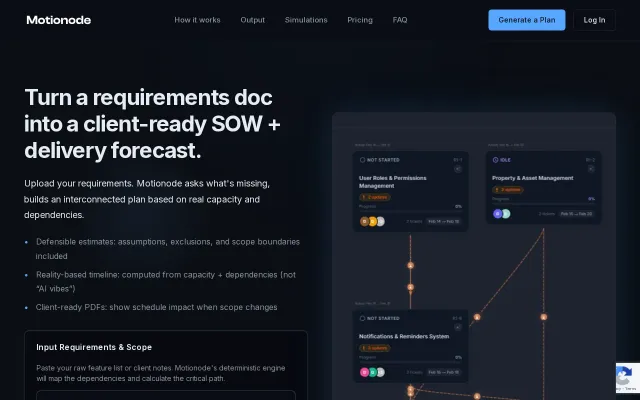
They split the work smartly: an LLM extracts deliverables from messy docs, then a deterministic 'physics' engine computes dependencies, capacity-based timelines, and a defendable critical path. Client-ready SOW PDFs, a scope-change ledger, and on-the-fly what-if scenarios feel immediately useful; I'd want to see proof it integrates cleanly with existing PM tooling and handles truly noisy inputs.