Infrastructure●Mid
A peer-2-peer network for sharing and accessing LLMs through OpenAI API
Distributed LLM inference over P2P instead of centralized APIs, but early-stage and unproven.
Bold BetBig Brain
modinfo
113mo ago
WebAssembly contracts defining merge operations solve decentralized consistency without servers.
Developers building censorship-resistant applications
IPFS · Holochain · Scuttlebutt
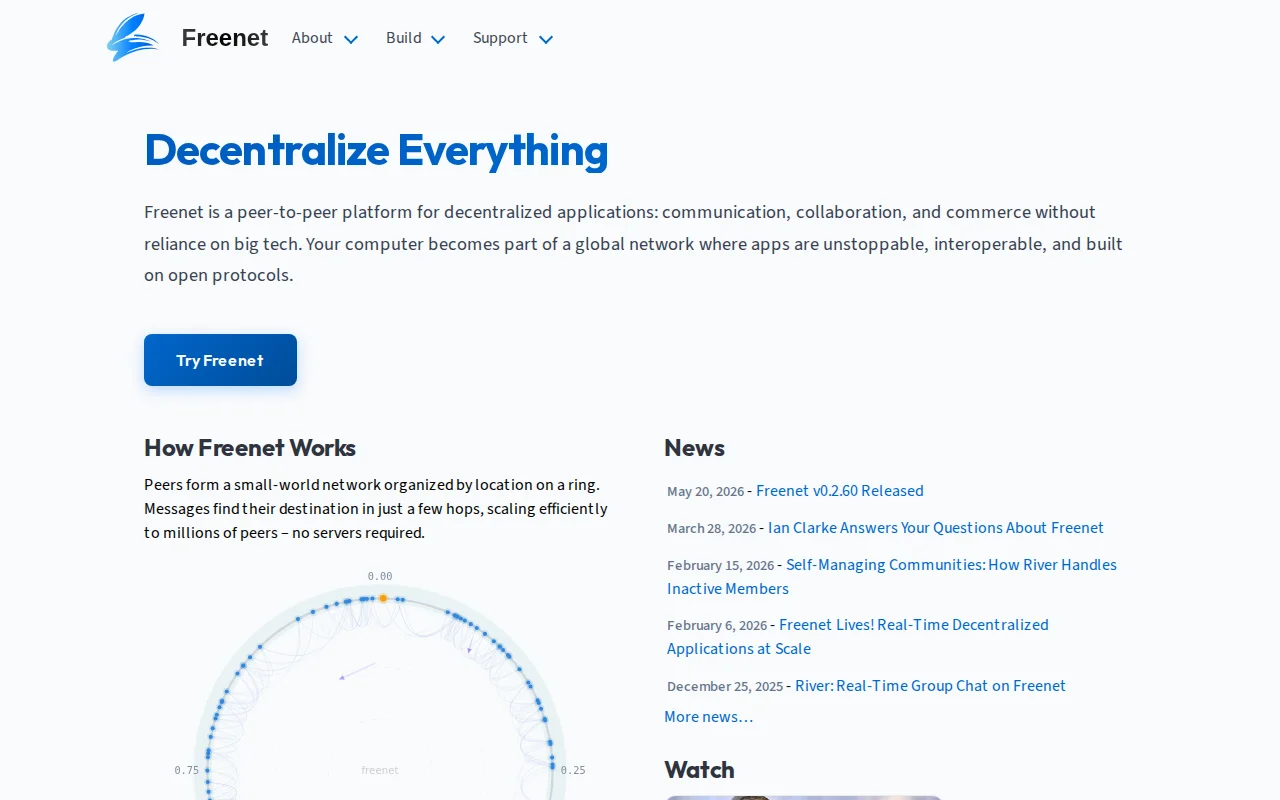
The new Freenet has been up and running since December along with some early applications like River[1], our decentralized group chat and Delta - a decentralized CMS. Users have already started to build their own apps on Freenet including games, and we have some interesting apps in development like Atlas, a search/recommendation engine.
Architecturally, this new Freenet is a global, decentralized key-value store where keys are webassembly contracts which define what values (aka "state") are valid for that key, how or when the values can be mutated, and how the state can be efficiently synchronized between peers.
We've developed a unique (AFAIK) solution to the consistency problem, every contract must define a "merge" operation for the contract's associated state. This operation must be commutative, meaning that you can merge multiple states in any order and you'll get the same end result.
This approach allows state updates to spread through the network like a virus[2], which typically achieves consistent global state in a few seconds or less.
Like the world wide web, Freenet applications can be downloaded from the network itself and run in a web browser - similar to single-page apps on the normal web. However, rather than connecting back to an API running in a datacenter, the webapp connects locally to the Freenet peer and interacts with Freenet contracts and delegates over a local websocket connection.
If you'd like to try Freenet we have convenient installers for the major desktop OSs but not yet mobile, and you can be chatting with other users on River within seconds[3]. Happy to answer any questions, you're also welcome to read our FAQ[4], or watch a talk I gave back in March[5].
[1] https://github.com/freenet/river [2] https://freenet.org/about/news/summary-delta-sync/ [3] https://freenet.org/quickstart/ [4] https://freenet.org/faq/ [5] https://youtu.be/3SxNBz1VTE0
Distributed LLM inference over P2P instead of centralized APIs, but early-stage and unproven.
Yet another benchmarking tool, but specifically for key-value stores instead of databases.
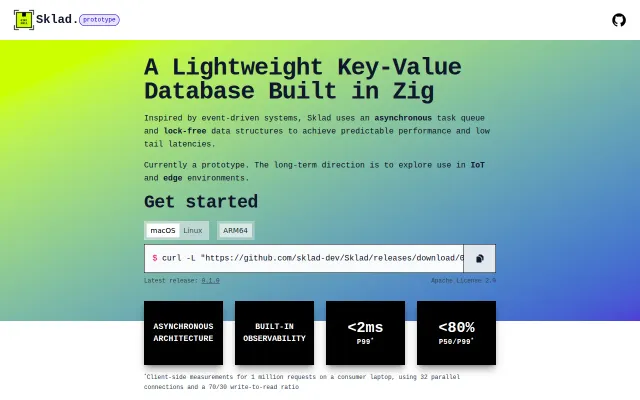
Lock-free skip-list memtable in Zig when Redis already dominates this space.
Robust SQLite wrapper, but SQLite itself and ORMs already handle this better.
P2P networking for AI agents, but central hubs still win on reliability.
LSM-tree with SSI, column families, and adaptive compaction—solid database primitives, nothing novel.