Back to browse
Gravity – interactive solar-system simulator, from Newton to Einstein

Gravity – interactive solar-system simulator, from Newton to Einstein

by qunabu·Jun 9, 2026·216 points·54 comments

AI Analysis

●●SolidRabbit HoleCozy

Guided tour builds orbital intuition step by step with real physics.

Strengths
  • Shows live energy drift (~1e-6%) to teach numerical integration limitations.
  • Real J2000 orbital elements with Voyager gravity assists at actual 1977-1989 dates.
  • Progressive pedagogy from two-body Newton to N-body to curved spacetime.
Weaknesses
  • Educational physics simulators like PhET already cover similar ground extensively.
  • Built over a weekend; long-term maintenance and feature roadmap unclear.
Category
Target Audience

Students and curious learners wanting to understand orbital mechanics

Similar To

PhET Simulations · Universe Sandbox · NASA Eyes

Post Description

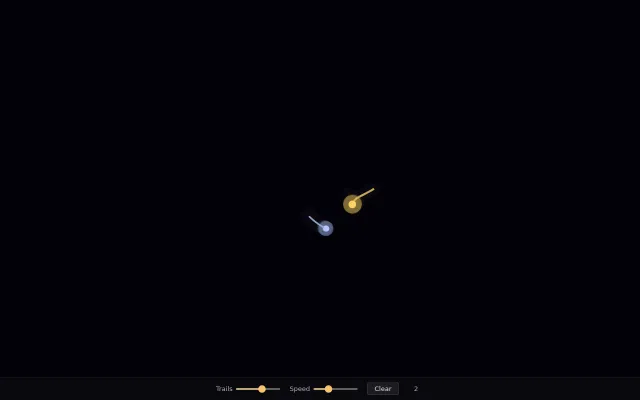
Just for fun and self education, I've built this over a weekend to teach myself why orbits exist, not just show planets going around. Something that was never clearly explain to me in school. It opens with a guided tour that builds the idea up step by step: two bodies and the equal/opposite force, inertia (the Sun is removed and Earth just drifts straight), then "an orbit is falling and continuously missing," cosmic velocities with a little rocket, Voyager 1 & 2's real gravity assists (the clock runs the actual 1977–1989 dates so the planets orbit into their grand-tour alignment and the slingshots line up), and it ends on Einstein — gravity as curved spacetime, the classic rubber-sheet well. What's real: every body uses its real radius/mass and J2000 orbital elements; positions come from solving Kepler's equation each frame. You can toggle to an N-body mode (symplectic leapfrog) that shows live energy drift (~1e-6%) so you can see the integrator is honest. The only thing faked is scale — at true scale you can't see anything — so there's a toggle between true scale and a log-remapped "visual" scale, with physics always running in real AU. Tech: TypeScript + Three.js + Vite, fully client-side, no backend, works offline (surface textures are generated procedurally from value-noise; only Earth uses a real image). Source: https://github.com/qunabu/Gravity

Happy to answer questions — and feedback on the physics or the explanations is very welcome. This project might be totally inaccurate in terms of real physics, this is how i do understand this on my own - i'm happy to confront this with reality

Similar Projects

Education●●Solid

AI Guided 3D atomic orbital simulation

Clean 3D quantum viz, but PhET simulations already cover this ground without AI.

SlickCozy
plumocracy
3123d ago
Education●●●Banger

Hacker's Guides

Travel guides for historic code like ELIZA make legacy source finally readable.

Niche GemRabbit HoleCozy
abrax3141
203d ago