AI/ML●●Solid
NeuroSync – An experimental Python library for neural cryptography
Academic neural cryptography with error correction—interesting research, niche application.
Big BrainRabbit Hole
TheDumb1
125mo ago
An experiment to query Xarray datasets with SQL
Running neural networks in SQL on climate data proves the relational array model works.
Climate scientists and data engineers working with gridded data
With down time on a warm beach during a heatwave, cool salty water giving me fresh ideas, I had an idea: what if we used Coiled's Geospatial benchmark discussion as a comprehensive overview of geo and climate queries. Are all of these common operations secretly relational, just with the wrong data model? Using Claude Code on the beach, I can confirm that this seemed to be the case: Claude and I publish a benchmark that illustrated how every common operation in geo and climate sciences (at the 100 TB range) were actually secretly relational operations: https://github.com/xqlsystems/xarray-sql/blob/main/docs/geos....
Most surprisingly of all, from these examples was that a core operation, regridding, was just a sparse matrix-vector product. Claude had pointed out to me that in this data model, matmul was just a `SUM(val * val) ... JOIN .. GROUP BY`. This has a direct parallel to einsum notation, but can be expressed in (arguably) elegant SQL syntax! This capability seemed to be greater than the sum of it's parts.
Back in the cool water of the Ionian, I thought about the implications of this more deeply. I reflected that, all of the Coiled benchmarks did, deep down, was _post process_ simulations that happen in numerical/array code. Why couldn't these physics calculations be push down into the database also, if we could so matmul in SQL? Then it hit me: maybe they could, if in addition to linear algebra, if SQL could do calculus! https://bsky.app/profile/al.merose.com/post/3mpbods7wts2y
Later on, I implemented autograd on top of DataFusion's visitor pattern based on JAX's implementation. In my simplified array model, it turns out that we only care about partial differentiation on the diagonal of the Jacobian, meaning that `grad()`, `jvp` and `vjp` are just row-wise operations! I then implemented a common physics calculation from the coiled benchmark that required gradients. From here, I realized if I can autograd in the database, why can't I create a neural network?
As I came back home, I created some slides, and presented this work to DataFusion's inaugural showcase: https://www.youtube.com/watch?t=1511&v=5o-4hL8vGPw&feature=y... I realized in this synthesis that SQL is not necessarily a toy language for writing neural networks, but in fact, may be highly desirable in the future due to the fundimental principles of relational databases: the logical layer should be independent from the physical layer. If that property holds, and a neural network is a series of relations, could we create a SOTA distributed system for training more easily? For example, if we had one global logical plan of dataflow, could we better distribute work on 1000+ GPUs?
Several scientists and engineers and I are working together to explore this weird world of relational arrays at https://xql.systems (discord link at the bottom if you want to get involved).
Academic neural cryptography with error correction—interesting research, niche application.
Single SQL query hybrid scoring beats multi-query RAG patterns for Django feeds.
Solid learning project, but dual numbers for auto-diff already exist in better libraries.
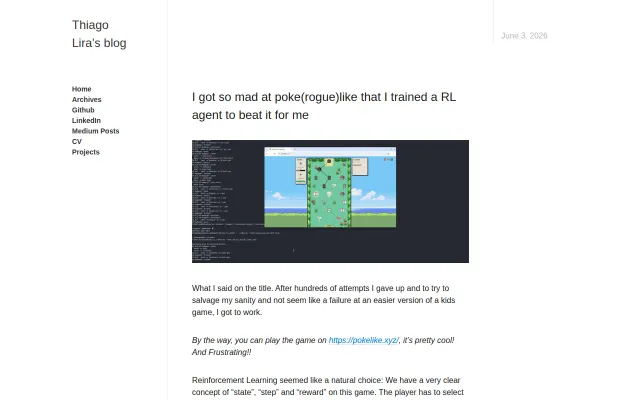
178K neural net beats Pokémon roguelike with clever 1386-dim state encoding.
River-aligned SQL formatter, but Prettier-SQL and PGQL already exist.
Full MLX power in Ruby: lazy arrays, Metal GPU, transformer layers—but Ruby adoption risk.