Back to browse
GitHub Repository

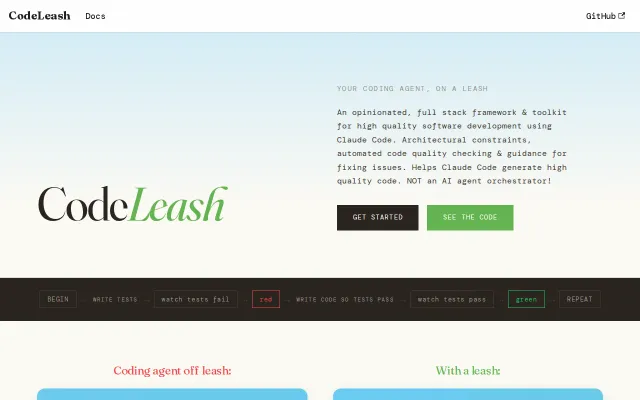
How real engineers run Claude Code and Codex: spec-driven planning, enforced TDD, persistent memory, and quality enforcement on all levels. Make your agents production-ready.

1,755 starsJavaScript

Claude Pilot – Claude Code is powerful. Pilot makes it reliable

by rittermax·Feb 17, 2026·2 points·0 comments

AI Analysis

●●SolidSolve My Problem

TDD enforcement and context preservation for Claude Code workflows, but hooks-on-every-edit pattern is established.

Strengths
  • Mandatory TDD cycle (RED/GREEN/REFACTOR) prevents test-skipping common in fast agents
  • Enforced linting, formatting, type-checking on every file edit—zero human discipline required
  • Context preservation across session compaction with monitoring prevents mid-task drift
Weaknesses
  • Builds on established tool-orchestration pattern (git hooks + environment enforcement); similar architecture in Continue, Aider
  • Target audience limited to Claude Code users; excludes other model providers
Target Audience

Backend developers building with Claude Code AI

Similar To

Continue · Aider · Claude Code IDE extensions

Post Description

Start a task, grab a coffee, come back to production-grade code. Tests enforced. Context preserved. Quality automated.

Claude Code moves fast but without structure, it skips tests, loses context, and produces inconsistent results — especially on complex, established codebases. I tried other frameworks — they burned tokens on bloated prompts without adding real value. Some added process without enforcement. Others were prompt templates that Claude ignored when context got tight. None made Claude reliably produce production-grade code.

So I built Pilot. Instead of adding process on top, it bakes quality into every interaction. Linting, formatting, and type checking run as enforced hooks on every edit. TDD is mandatory, not suggested. Context is monitored and preserved across sessions. Every piece of work goes through verification before it's marked done.

Pilot optimizes for output quality, not system complexity. The rules are minimal and focused. There's no big learning curve, no project scaffolding to set up, no state files to manage. You install it in any existing project — no matter how complex — run `pilot`, then `/sync` to learn your codebase, and the quality guardrails are just there — hooks, TDD, type checking, formatting — enforced automatically on every edit, in every session.

The result: you can actually walk away. Start a `/spec` task, approve the plan, then go grab a coffee. When you come back, the work is done — tested, verified, formatted, and ready to ship. Hooks preserve state across compaction cycles, persistent memory carries context between sessions, quality hooks catch every mistake along the way, and verifier agents review the code before marking it complete. No babysitting required.
Similar Projects

AI/ML●●Solid

Comfy Pilot – MCP server that lets Claude Code edit ComfyUI workflows

This repo actually hands an LLM live control over a ComfyUI graph — list node types, create/connect/delete nodes, tweak params, run queues and even view preview images — via an MCP server and an embedded terminal. The idea of treating the workflow as a JSON DAG so each edit maps to a tool call is smart and pragmatic; it's the kind of niche automation that'll save hours for people iterating image pipelines. My main caveat: giving a model direct edit rights raises obvious safety/permission questions and ties the UX tightly to Claude.

WizardryNiche Gem
0xConstantine
204mo ago