Developer Tools●●Solid
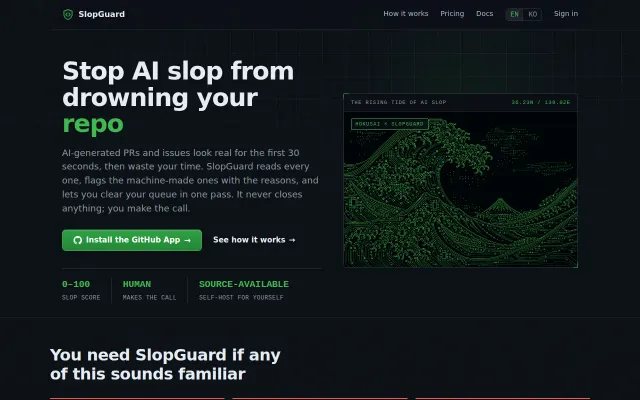
SlopGuard, a GitHub App that quarantines AI slop PRs and issues
Human-in-the-loop AI detection that never auto-closes, unlike GitHub's native filters.
Solve My ProblemSlick
blue-b
206d ago
Find your first PR! Give this repo a STAR ☝️☝️☝️☝️
Health score + AI difficulty tiers solve real friction in GitHub's 'good first issue' search.
Open source newcomers and junior developers seeking first contributions
Code Triage · First Timers Only · GitHub Advanced Search
IssueScout adds two things on top of GitHub's search:
1. A Community Health Score (0-100) per repository — computed from 7 factors: CONTRIBUTING.md, license, code of conduct, recent activity, star count, issue response time, and PR merge rate. A score of 80+ means someone will actually review your PR.
2. AI Difficulty Estimation — a rule-based keyword analyzer runs first. If confidence is below 80%, it falls back to GPT-4o-mini. A purple sparkle shows when AI was used.
Architecture choices that might be interesting to HN: - Each user's GitHub OAuth token powers their own API requests (5K/hr per user) instead of a single server PAT. Scales linearly with users. - Two-level caching: issue difficulty cached 24h, repo health cached permanently with stale-while-revalidate at 48h. The IndexedRepo collection grows over time into a shared database of scored repos. - Two-phase progressive loading: raw GitHub results return instantly, enrichment fills in asynchronously. No spinners. - Rule-based AI first, LLM fallback only when needed. Keeps costs near zero for most queries. Stack: Next.js 16, TypeScript, MongoDB Atlas, GitHub GraphQL API, OpenAI GPT-4o-mini, Vercel.
Live at https://issuescout.dev — sign in with GitHub to try it.
MIT licensed. Full architecture docs: https://github.com/turazashvili/issuescout.dev/blob/main/doc...
Human-in-the-loop AI detection that never auto-closes, unlike GitHub's native filters.
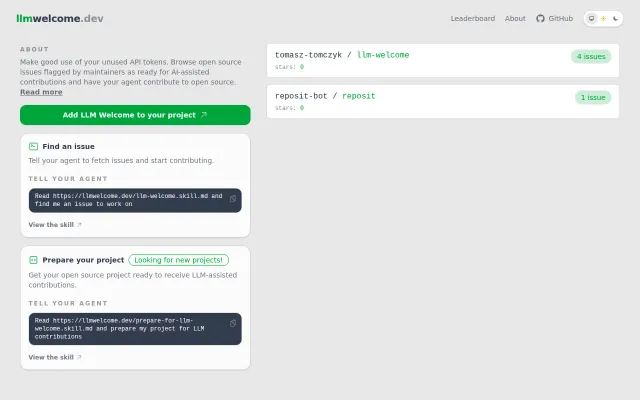
Solves the unsolicited AI PR problem via explicit opt-in, not permission-after-the-fact.
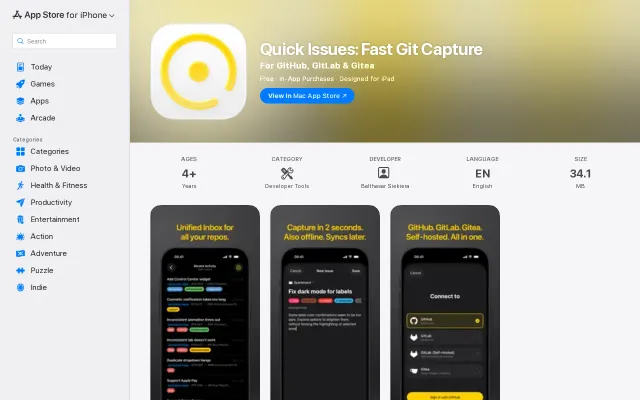
Offline issue capture for GitHub/GitLab/self-hosted, but market is small and fragmented.
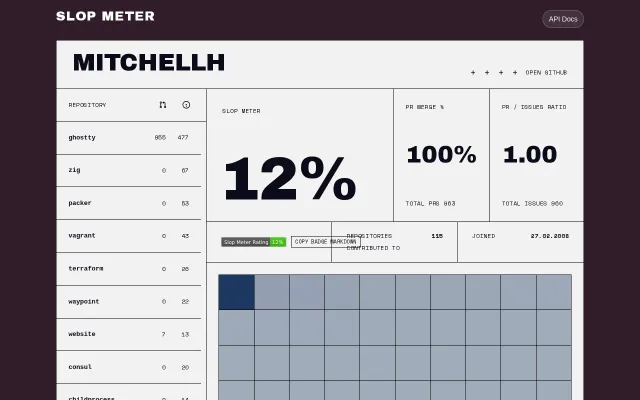
Quantifies contributor signal-to-noise; solves real open-source triage pain.
AI wrapper for GitHub Issues when Linear and Copilot already handle this.
Another AI issue tracker when Intercom and Zendesk already do this.