Data●●Solid
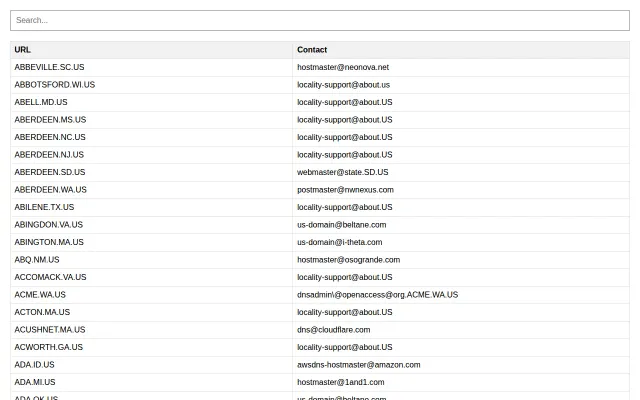
Easy Locality Domain Lookup
Finally exposes the messy reality of local government DNS admin contacts.
Solve My ProblemNiche Gem
ronbenton
201mo ago
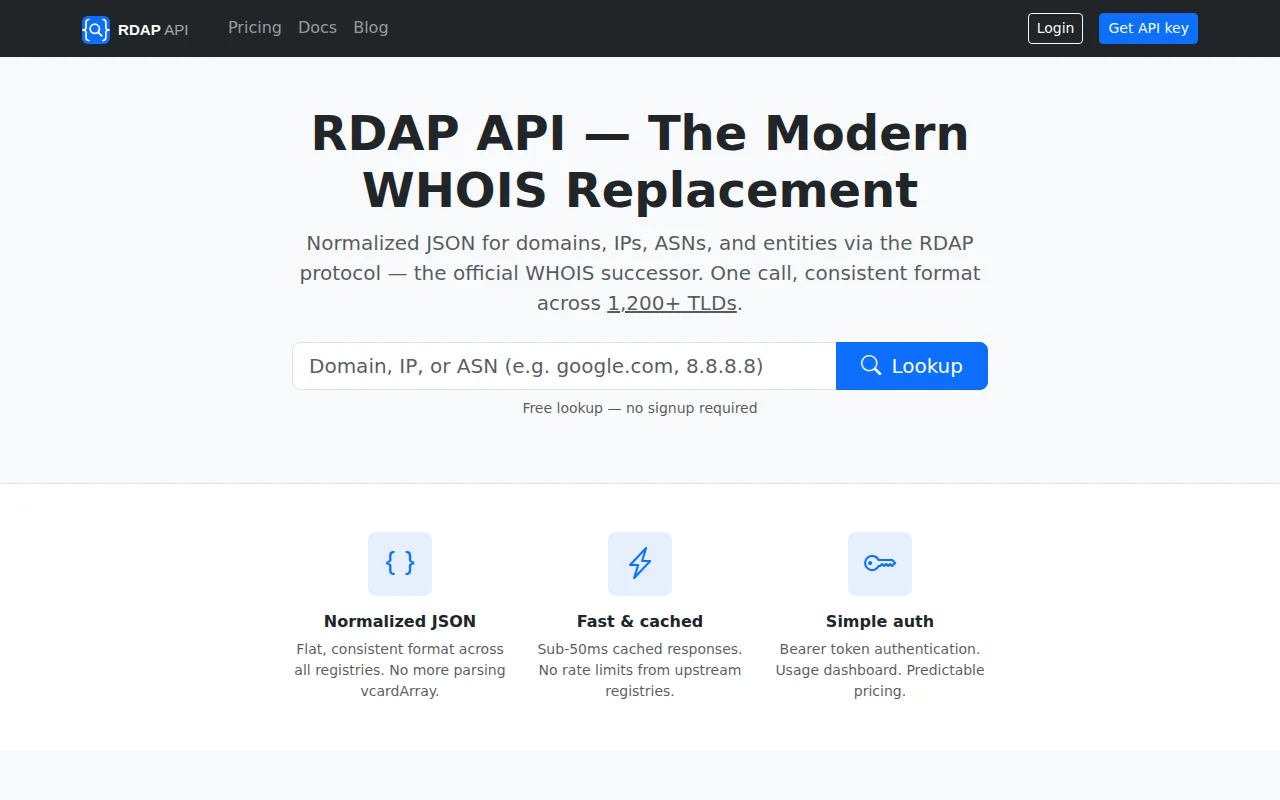
Fixes WHOIS's broken successor: one endpoint, consistent schema, handles multi-server routing automatically.
Backend developers, security teams, and SaaS platforms needing domain/IP registration and abuse contact data at scale.
WHOIS API providers (DomainTools, Whoisology) · Direct RDAP servers (IANA registry)
There is no single server. You have to check the IANA bootstrap registry to find which server handles each TLD, and some ccTLDs have working RDAP servers that are not even listed there. For .com and .net, the registry only has basic data. You need a second request to the registrar server to get contacts and abuse info. Then there is vcardArray, a deeply nested array-of-arrays format for contact data. And every server has its own rate limits.
I built an API that does all of that and gives you clean JSON back. One endpoint, same schema for every TLD. Here is what you get for google.com with ?follow=true (follows the registrar link automatically):
{ "domain": "google.com", "registrar": { "name": "MarkMonitor Inc.", "iana_id": "292" }, "dates": { "registered": "1997-09-15T04:00:00Z", "expires": "2028-09-14T04:00:00Z" }, "nameservers": ["ns1.google.com", "ns2.google.com", "ns3.google.com", "ns4.google.com"], "entities": { "registrant": { "organization": "Google LLC", "country_code": "US" } } }
You also get status codes, DNSSEC, abuse contacts, etc. There is a free lookup tool on the homepage to try it, no signup needed.Supplemental servers. The IANA bootstrap only covers ~1,200 TLDs. I keep a list of 30 extra RDAP servers (for TLDs like .io, .de, .me, .us) that work but are not registered with IANA. Synced daily.
Registrar follow-through. For thin registries like .com, the registry only has dates and nameservers. The registrar has the rest on a different server. The API follows that link and merges both.
SDKs. Open source clients for Python, Node.js, PHP, Go and Java.
Responses are cached for 24 hours to reduce load on upstream RDAP servers.
This is my first SaaS, just launched. Would love honest feedback.
The API starts at $9/mo with a 7-day free trial.
Finally exposes the messy reality of local government DNS admin contacts.
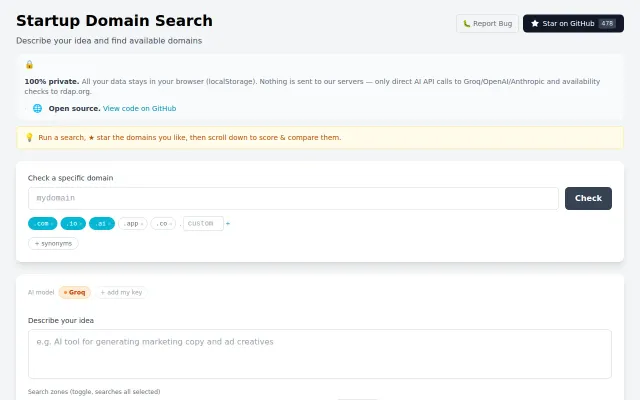
Client-side AI domain generator with custom scoring beats Namecheap's data-harvesting tools.
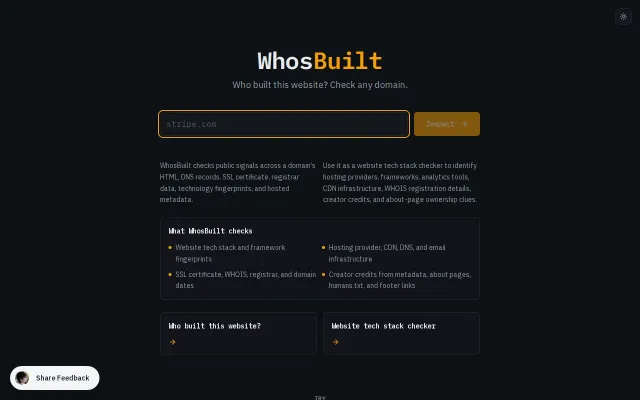
Humans.txt and creator credit detection is clever, but BuiltWith already dominates this space.
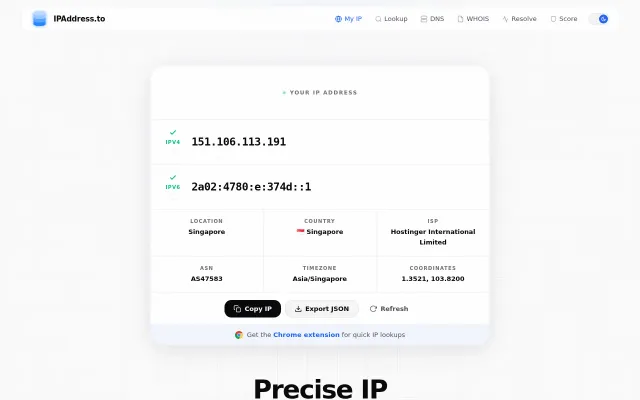
Clean IP lookup interface, but ipinfo.io and similar tools already dominate this space.
Yet another IP lookup extension, but right-click context menu is handy.
Searchable JSON compression at 7.7% with 0.085ms random lookups; skips 99% of pages.