Developer Tools●●Solid
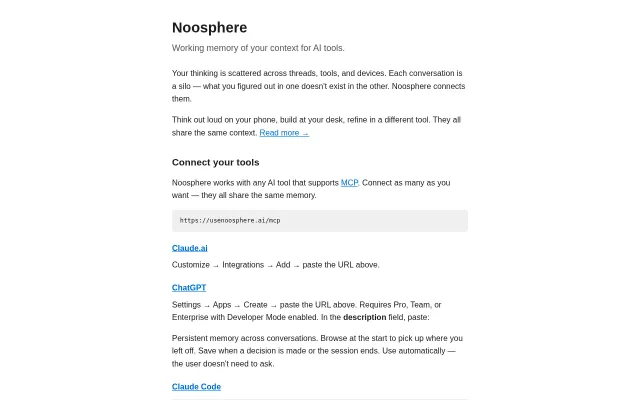
I made a tool to sync my brainstorm with AI across tools and devices
MCP memory server for AI context bleed across tools when Claude Code and Cursor work independently anyway.
Solve My ProblemCozy
mmndaniel
203mo ago
Portable AI memory across Claude, GPT, Gemini using your own Postgres knowledge graph.
Power users of multiple AI models who want portable context and privacy from vendor lock-in
Anthropic's MCP Protocol (ecosystem standard) · Cursor's context awareness · Continue's codebase integration
I pay for ChatGPT, Claude, Cursor, and use Gemini through work. Four vendors, four separate conversation histories, four profiles of how I think. None of them talk to each other. Switch providers and you start over.
So I built a system where the memory is mine. I run a knowledge graph in Postgres (Supabase, free tier) with pgvector for semantic search. A small MCP server reads and writes to it. That server sits behind an MCP Gateway on a $6/month VPS, along with Brave Search and a GitHub server. TypingMind connects to the gateway as a BYOK client -- any model, any device, same brain.
https://github.com/kaspnilsson/digital-twin-playbook
When I switch from Claude to GPT-5 to Gemini, the new model picks up where the old one left off. After three months of daily use, the AI knows my project architectures, my preferences, my side projects. I never re-explain any of it.
The MCP server is MIT-licensed: https://github.com/kaspnilsson/mcp-memory-supabase The playbook walks through the full setup -- Supabase schema, VPS hardening, Caddy, systemd, the system prompt that makes tool routing work: https://github.com/kaspnilsson/digital-twin-playbook
What it costs me: ~$45/month ($6 VPS + ~$36 API compute via OpenRouter + $3 amortized TypingMind license). More than a $20 subscription. But the $20 price is subsidized, and my data stays on my server. What does not work well: TypingMind is a PWA, not a native app. Voice is rough. iOS kills background processes on long tool chains. MCP config does not sync across devices. You are your own SRE.
This is not a consumer product. If you want polish, use Claude.ai. If you want to own the context that makes your AI useful, this is how I did it!
MCP memory server for AI context bleed across tools when Claude Code and Cursor work independently anyway.
Model switching mid-conversation plus cross-chat memory, but ChatGPT app and Claude app already own this.
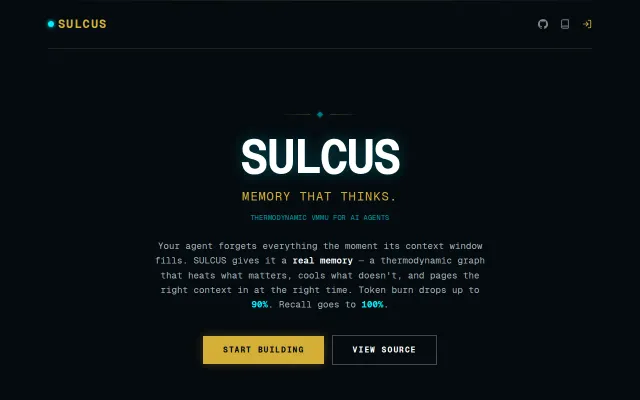
Thermodynamic memory decay beats passive vector search—90% token reduction claimed.
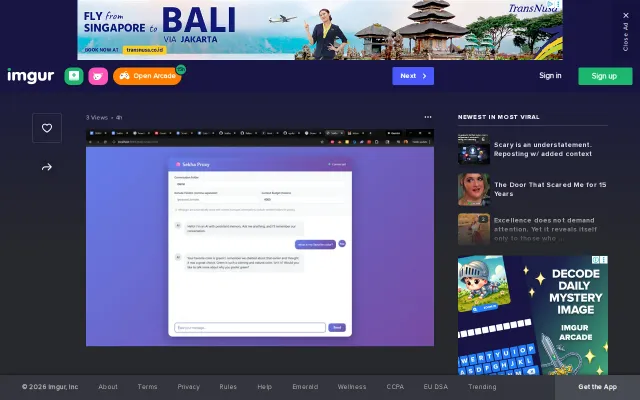
The core idea is simple and pragmatic: attach a persistent, SQLite-backed vector store to any model so conversations don't vanish after a single context window. The repo leans into portability (Rust, self-hosted, AGPL) and the UI shows sensible controls like conversation folders and a context-budget token slider — useful details that suggest this is built for real use rather than a demo. My worry: retrieval quality, scaling and access controls will be the real battleground, not the clean chat UI.
Manually converting PyTorch models to CoreML so you don't have to call cloud APIs.
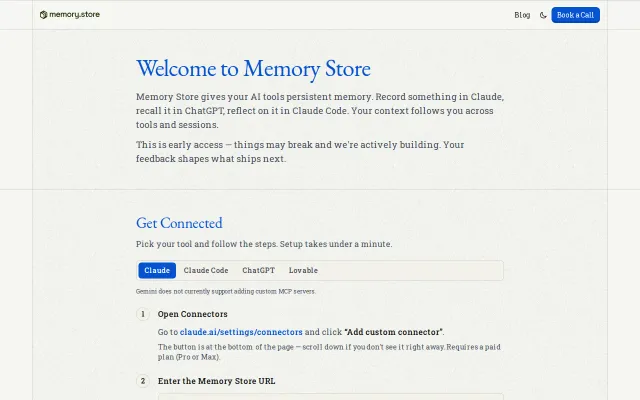
Memory sync across Claude/ChatGPT, but unproven competitive advantage over session-scoped context.