Productivity●Mid

WikiBonsai - A Legible Knowledge Layer
Structured plain text spec aiming to replace flat RAG embeddings.
Big BrainBold Bet
manunamz
403mo ago
Where teams and AI build shared understanding
Content-hash drift detection beats markdown walls for AI agent specs.
AI/LLM tooling builders, teams fighting documentation drift
Sourcegraph Cody · Cursor · Continue
This has been a problem before – underspecified projects, specifications going out of sync with the first line of code. We've just amplified it now.
A lot of people (myself included) have tried to maintain good specifications in markdown to give LLMs and humans maximal context. But this is still walls of text that poison anyone's context, regardless of their artificiality.
So I built a way to model knowledge as a graph that both people and LLMs can consume progressively – by navigating the graph or searching for specific connectivity patterns rather than ingesting everything at once.
At its core it's an open specification for layers that add progressively more semantic value: starting with prose, growing into terminology, tasks, concepts, API surfaces, and structured plans.
The most critical component is a layer that maps artifacts (such as code) to the knowledge model with good enough precision to track drift and coverage automatically.
Structured plain text spec aiming to replace flat RAG embeddings.
Git for the 'why': intent DAG alongside code DAG, built for AI agents.
Cross-provider agent memory is clever, but LLM context windows keep growing and RAG is already standard.
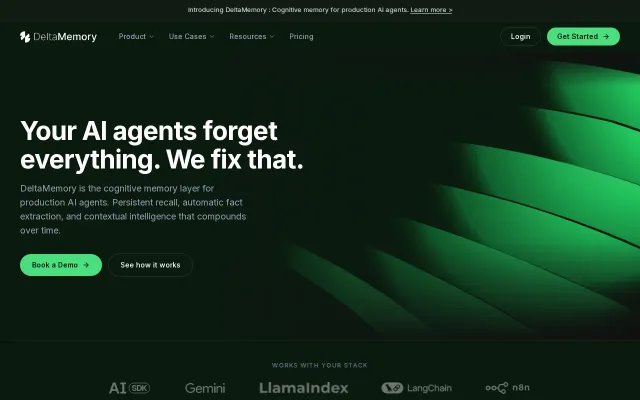
Knowledge graph compression (3,714x token ratio) is impressive, but 'persistent agent memory' is crowded territory.
Turns chat history into structured 'belief' and 'cognitive pattern' blocks you can inject into prompts, with simple APIs like run_reflection and run_synthesis that read like a research prototype. It's smart about separating V1 (domain beliefs) from V2 (transferable cognitive patterns), but it's clearly early-stage — tiny repo, Ollama-only workflow, and few commits mean you should treat it as an experimental MVP rather than a drop-in production memory system.
Yet another Figma-to-code tool when Anima and Builder.io already exist.