AI/ML●●Solid
EvalLens – Open-source tool to evaluate structured LLM outputs
Schema conformance checks beat generic text evals for JSON-heavy LLM pipelines.
Niche GemShip It
simonrendon
102mo ago
Finally separates JSON validity from actual value hallucination in LLM outputs.
ML engineers building deterministic LLM workflows
JSONSchemaBench · DeepJSONEval · LLMStructBench
The model may return the schema you want, but with hallucinated values like `invoice_date` being off by 2 months or the transcript array ordered wrongly. The JSON is valid, but the values are not.
Structured output today is a big part of using LLMs, especially when building deterministic workflows.
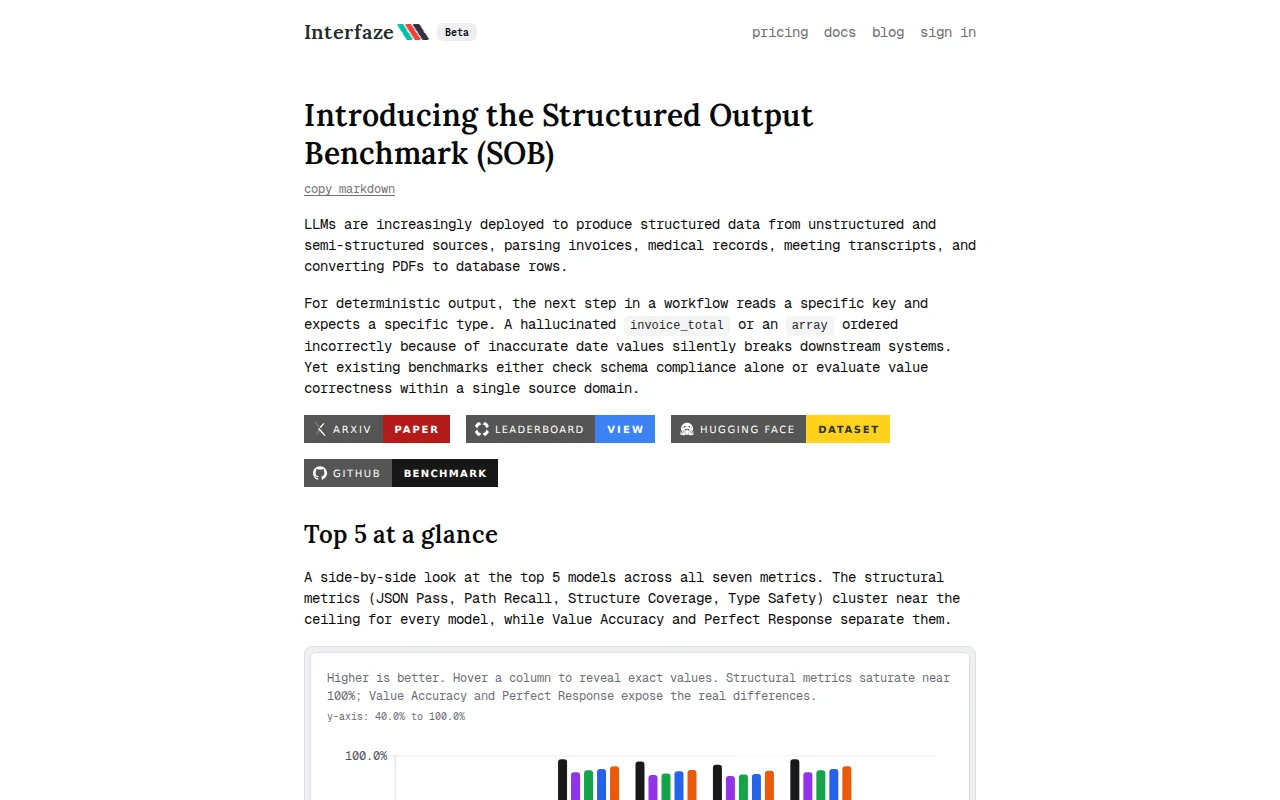
Current structured output benchmarks (e.g., JSONSchemaBench) only validate the pass rate for JSON schema and types, and not the actual values within the produced JSON.
So we designed the Structured Output Benchmark (SOB) that fixes this by measuring both the JSON schema pass rate, types, and the value accuracy across all three modalities, text, image, and audio.
For our test set, every record is paired with a JSON Schema and a ground-truth answer that was verified against the source context manually by a human and an LLM cross-check, so a missing or hallucinated value will be considered to be wrong.
Open source is doing pretty well with GLM 4.7 coming in number 2 right after GPT 5.4.
We noticed the rankings shift across modalities: GLM-4.7 leads text, Gemma-4-31B leads images, Gemini-2.5-Flash leads audio.
For example, GPT-5.4 ranks 3rd on text but 9th on images.
Model size is not a predictor, either: Qwen3.5-35B and GLM-4.7 beat GPT-5 and Claude-Sonnet-4.6 on Value Accuracy. Phi-4 (14B) beats GPT-5 and GPT-5-mini on text.
Structured hallucinations are the hardest bug. Such values are type-correct, schema-valid, and plausible, so they slip through most guardrails. For example, in one audio record, the ground truth is "target_market_age": "15 to 35 years", and a model returns "25 to 35". This is invisible without field-level checks.
Our goal is to be the best general model for deterministic tasks, and a key aspect of determinism is a controllable and consistent output structure. The first step to making structured output better is to measure it and hold ourselves against the best.
Schema conformance checks beat generic text evals for JSON-heavy LLM pipelines.
Fail-closed policy layer blocks LLM tool calls before execution, no LLM in decision path.
Deterministic FSM guards LLM outputs to prevent hallucination spirals in .NET.
Pytest syntax for LLM testing avoids LLM-judge cost, but feature parity vs. LangSmith and Braintrust unproven.
Yet another hallucination checker when Guardrails and LMQL already cover this.
Treating LLM output like compiler input — with typed style guides, required-section enforcement, and explicit Confidence/LostElements on transformations — is a clever, non-obvious approach that could actually raise the signal-to-noise on generated content. The product shows useful practical features (export to PDF/HTML/JSON, jurisdiction-aware legal drafting, slide generation), but the real test will be how maintainable and authorable those rule sets are in messy, real-world workflows.