Data●●Solid
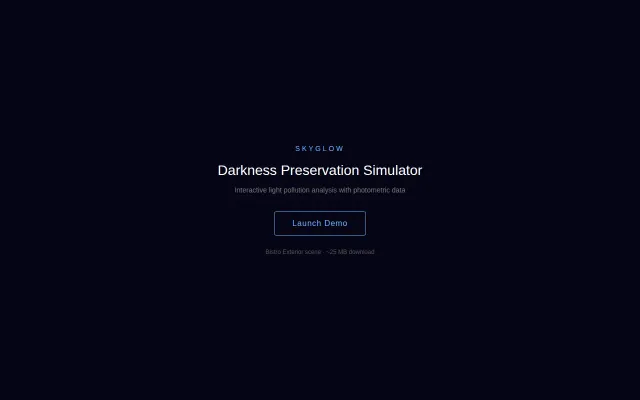
Browser-based light pollution simulator using real photometric data
Real photometric data visualization in the browser using WebAssembly.
Niche GemSlick
holg
101mo ago
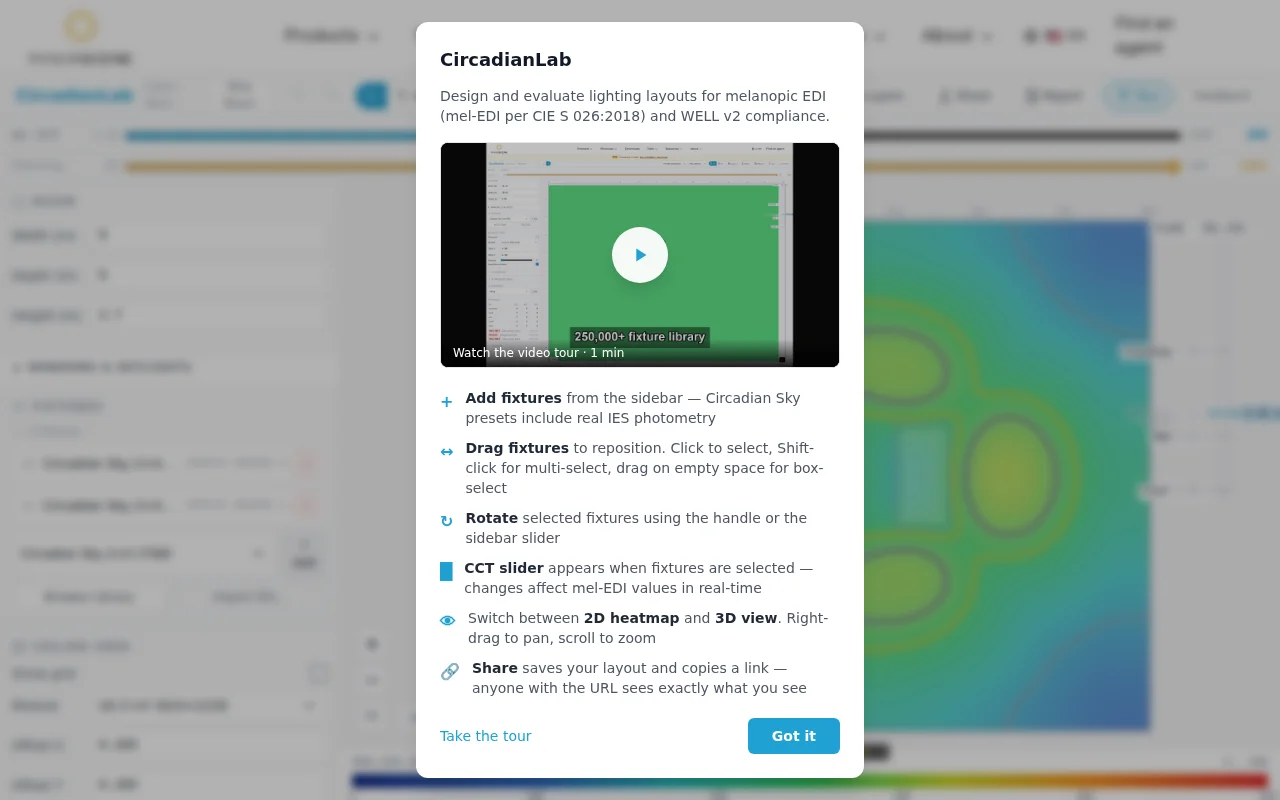
Real-time radiosity solver for WELL v2 compliance running entirely in the browser.
Lighting designers, architects, and WELL certification consultants
Dialux · Relux · AGi32
It has a database of 400,000+ IES files from 81 lighting manufacturers and supports easy sharing of scenes/configs with other people.
Daylight uses the NREL Solar Position Algorithm and a Perez clear / intermediate / overcast sky model, mixed into the same radiosity solve as electric fixtures. Sun and sky are added as initial flux on every patch, then bounced through the same form-factor network. Form factors via Monte Carlo with visibility tests, then a Gauss-Seidel 3-bounce iterative solve.
My company (Innerscene) makes "daylight" luminaires. We built CircadianLab to address a specific gap (no browser-based way to verify WELL v2 mel-EDI compliance before specifying), but it works with any IES file from any manufacturer, not just our line. For mel-EDI you need SPDs to accurately calculate but CCT is a good proxy.
Write-up + demo videos: https://www.innerscene.com/blog/introducing-circadian-lab
Of interest to HN crowd, there are measurable productivity/performance enhancements that can be achieved with higher mel-EDIs which is why the design community is now incorporating this into building design. If you haven't dug into any of the research before checkout: https://www.innerscene.com/research?topic=Workplace+Performa...Here is an example scene with a classroom and sunlight coming through a window, showing foot candles as a heatmap:
3d view: https://www.innerscene.com/tools/circadian-lab?share=b104262... 2d view: https://www.innerscene.com/tools/circadian-lab?share=456ad19...
Happy to answer questions on anything related.
Real photometric data visualization in the browser using WebAssembly.
Real LDT files driving live sky-glow grades in a browser — that's genuinely wild.
Milkdrop running in the browser via WebGPU is pure nostalgia fuel.
WebGPU-accelerated random matrix visualizer; deep research appeal, narrow audience.
Browser-based GBM modeling keeps your financial data private while running simulations.
WebGPU force-directed graphs, but Sigma.js, Cytoscape, and D3 already dominate this space.
![Milkdrop Visualizations with WASM+WebGPU [TW: flashing lights]](/screenshots/47965960_thumb.webp)